Critical Control Points: CCP Decision Tree
Enter a process step and its hazard, answer the four decision tree questions, and see whether the step is a critical control point or not, with the examples that FDA Food Code Annex 4 gives.
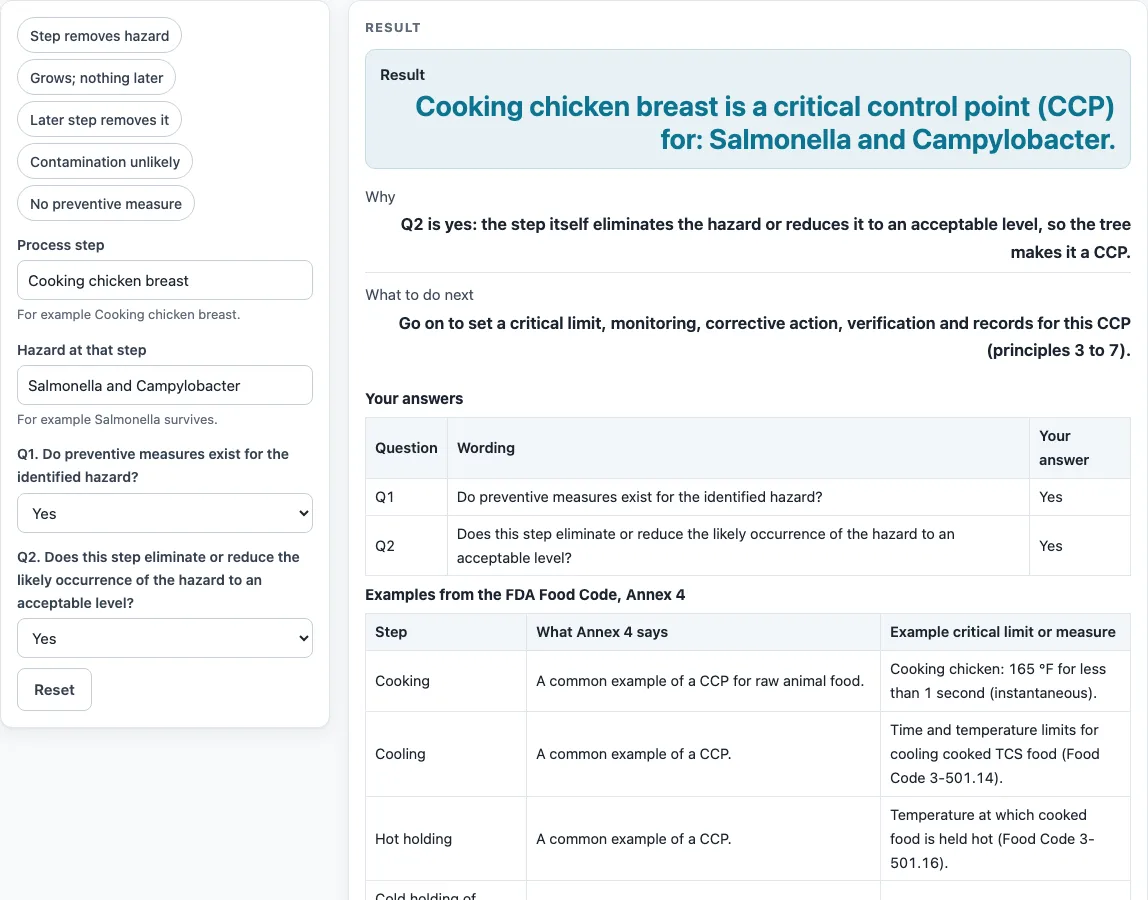
How to use this CCP decision tool
- Type the process step into the process step box, such as “Cooking chicken breast.” The box takes up to 80 characters. If it is empty, the tool uses “This step.”
- Type the hazard into the hazard box, also up to 80 characters, such as “Salmonella and Campylobacter.” If it is empty, the tool uses “the hazard.”
- Answer Q1: Do preventive measures exist for the identified hazard? Choose yes or no. A no ends the path as not a CCP.
- If Q1 is yes, answer Q2: Does this step eliminate or reduce the likely occurrence of the hazard to an acceptable level? A yes makes the step a CCP.
- If Q2 is no, answer Q3: Could contamination with the hazard occur in excess of acceptable levels, or could it increase to unacceptable levels? A no ends the path as not a CCP.
- If Q3 is yes, answer Q4: Will a subsequent step eliminate the hazard or reduce its likely occurrence to an acceptable level? A yes means not a CCP. A no means it is a CCP.
- If a question you need is left blank, the tool shows an error asking for yes or no.
- Read the verdict sentence, the “why” line, and “what to do next.” For a CCP, the next steps are critical limit, monitoring, corrective action, verification, and records.
Questions the tool does not reach are hidden, and any answers to them are ignored. Presets cover each of the five outcomes.
What is a critical control point?
A critical control point (CCP) is a step in a food process where a control can prevent, eliminate, or reduce a food safety hazard to an acceptable level. This tool classifies a step as a CCP only when your answers to the decision questions lead there.
The FDA Food Code, Annex 4, lists cooking, cooling, hot holding, and cold holding of ready-to-eat TCS food as common examples of CCPs. It names reheating and receiving as points of control. First-in first-out and refrigerating non-TCS food are quality measures, not CCPs, unless they also serve food safety.
A critical limit is the value a CCP must meet. Annex 4 gives two examples: cooking chicken to 165 °F for less than 1 second, and a sushi rice final pH below 4.2.
How does the four-question decision tree decide?
The tree asks four questions in order, and each answer either ends with a verdict or sends you to the next question. Q1 asks whether preventive measures exist for the hazard. A no ends the path as not a CCP, and the hazard control must be recorded somewhere else.
Q2 asks whether this step eliminates or reduces the hazard to an acceptable level. A yes makes the step a CCP. Q3 asks whether contamination could exceed acceptable levels or rise to unacceptable levels. A no ends the path as not a CCP. Q4 asks whether a subsequent step will eliminate the hazard or reduce it to an acceptable level. A yes means not a CCP, and a no means it is a CCP.
Two examples show the routing. Raw chicken in cold storage gives Q1 yes, Q2 no, Q3 yes, Q4 yes, so it is not a CCP because a later cooking step controls the hazard. Hot holding soup gives Q2 no, Q3 yes, Q4 no, so it is a CCP.
The question wording comes from a UF/IFAS Extension publication that attributes the tree to the NACMCF. The FDA pages show the tree only as an image. The “modify the step” branch found in some published versions is not included, because no readable source gave its wording.
The sections used here are identical in the 2022 and 2026 editions of the FDA Food Code. Your local health department adopts its own edition and may be stricter, so its adopted code governs.
Sources (checked 15 October 2026): edis.ifas.ufl.edu · ask.ifas.ufl.edu · fda.gov · fda.gov · fda.gov · fda.gov
Worked examples
| Input | Result |
|---|---|
| Step: Cooking chicken breast | Cooking chicken breast is a critical control point (CCP) for: Salmonella and Campylobacter. |
| Step: Hot holding soup | Hot holding soup is a critical control point (CCP) for: Clostridium perfringens growth. |
| Step: Raw chicken in cold storage | Raw chicken in cold storage is not a critical control point for: Salmonella. |
| Step: Storing canned beans | Storing canned beans is not a critical control point for: Foreign object. |
| Step: Step with no preventive measure | Step with no preventive measure is not a critical control point for: Hazard without a control. |
Calculated by the tool above; open it with the same values to see each step.
Frequently asked questions
What happens after a “not a CCP” verdict?
The tool asks you to write down how and where the hazard is controlled instead. It also says to test the step that does control it. The hazard still needs a control, even though this step is not the CCP.
Which Food Code edition does this tool follow?
The sections used here are identical in the 2022 and 2026 editions of the FDA Food Code. Your local health department adopts its own edition and may be stricter, so its adopted code is the one that applies.
Who sets the critical limit for a CCP?
The tool does not set limits; after a CCP verdict it tells you to go on to set a critical limit. Annex 4 of the FDA Food Code gives examples, such as cooking chicken to 165 °F for less than 1 second. Your local health department’s adopted code governs and may be stricter.
Why does the tool ask about a later step?
Q4 asks whether a subsequent step will eliminate the hazard or reduce it to an acceptable level. If a later step does this, the current step is not a CCP. Raw chicken in cold storage is an example, because a later cooking step controls the hazard.
Do I enter temperatures or other numbers?
No. The inputs are the process step, the hazard, and a yes or no answer for each question reached. Critical limits, monitoring, and records come after the verdict and are not entered on this page.
Is anything I type uploaded?
No. The tool runs in your browser, nothing is uploaded, there is no sign-up, and it is free.
Related tools
- HACCP Plans and Critical Control Points: use it to see every HACCP page on this site in one place.
- HACCP Plan Example: use it to see how a completed plan is laid out once you have identified your CCPs.
- HACCP Plan for a Restaurant: use it when you are checking CCPs for a restaurant kitchen.
- HACCP Plan Template: use it when you want a blank structure to fill in after a verdict.
- What Is a HACCP Plan?: use it to learn how CCPs fit into the wider plan.
- When Is a HACCP Plan Required?: use it to check whether a plan applies to your operation.
- Food Temperatures, Holding and Cooling: use it for the cooling, hot holding and cold holding limits behind common CCPs.
- Corrective Action Form for Food Safety: Fill In, Print or Keep a Log: use it to record what you did when a critical limit was missed.