Food Safety Checklist
Choose daily, weekly or both; each check sits under one of the five risk factors or the good retail practices and names its Food Code section.
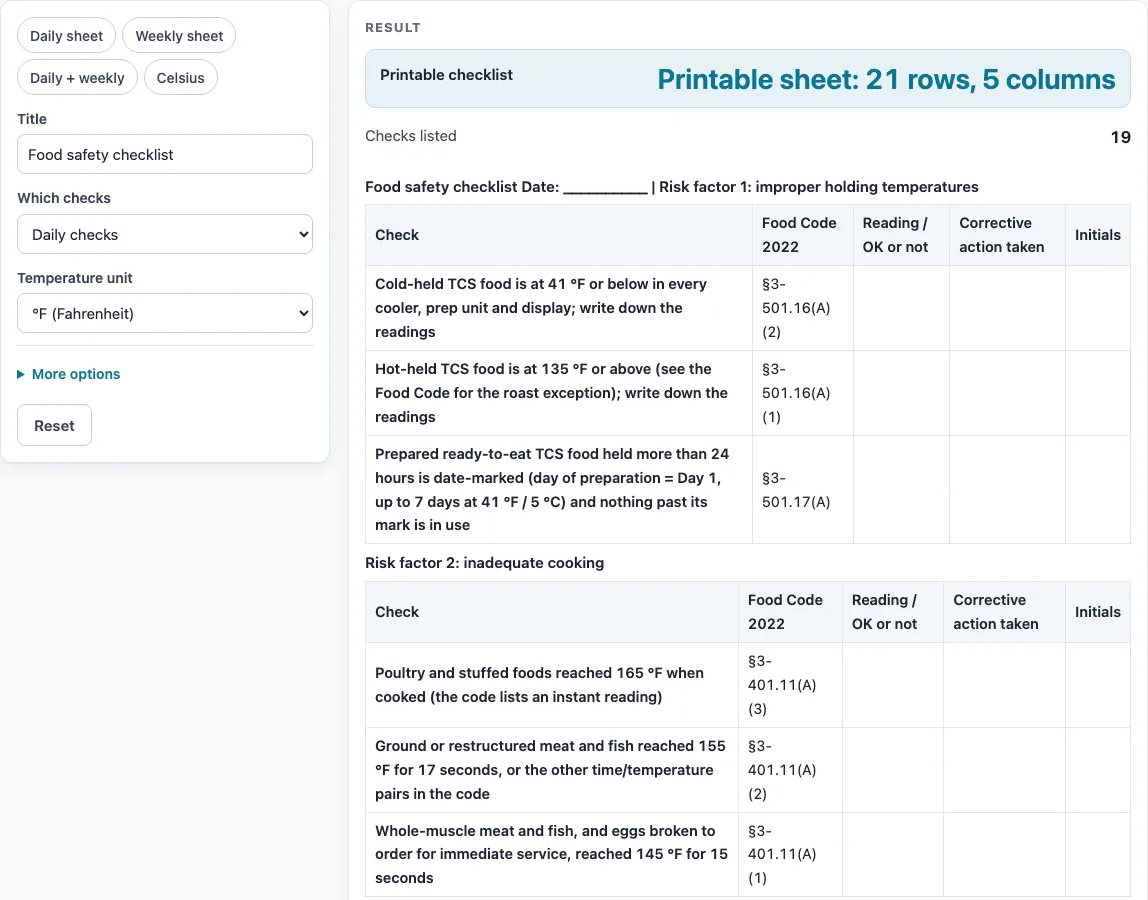
How to use the Food Safety Checklist
- Open the “Which checks” select and choose daily checks (19), weekly checks (7) or both (26). When you choose both, each row is tagged with its frequency.
- Choose the temperature unit, °F or °C. It changes the temperatures written in the check text.
- Switch the “Food Code section column” on or off. When it is on, each row shows its Food Code 2022 section number.
- Switch the “Corrective action column” on or off, depending on whether you want to record actions on the sheet.
- Set the number of blank lines at the end, from 0 to 15. The default is 2. If you enter more than 15, the tool caps it at 15 and shows a warning.
- Work down each table. For each check, enter the reading in the “Reading / OK or not” column and mark whether it was OK or not.
- If a reading was not OK, describe the action you took in the “Corrective action taken” column.
- Write your initials in the “Initials” column so the entry shows who recorded it.
- Click “CSV” to download the tables as a file, or click “Print” to print them.
Nothing is uploaded, so keep your downloaded file or printed copy yourself. If you want a separate record for a different task, the related tools below may help.
What are the five major risk factors the sheet is built on?
The sheet is organised under the five major foodborne-illness risk factors named in the FDA Food Code 2022 Preface: improper holding temperatures, inadequate cooking, contaminated equipment, food from unsafe sources and poor personal hygiene. Each factor becomes its own table of rows, so you can check one area at a time.
What temperatures does the holding check use?
Holding rows use Food Code 3-501.16(A): hot food is held at 135 °F (57 °C) or above, and cold food at 41 °F (5 °C) or below. Hot-held food has a roast exception listed in the Food Code, which the check text points to. Date marking follows 3-501.17(A): for prepared ready-to-eat TCS food held more than 24 hours, Day 1 is the day of preparation, and the rule allows 7 days at 41 °F. The receiving row uses 3-202.11(A), which asks whether refrigerated TCS food was at 41 °F (5 °C) or below when it arrived.
What cooking temperatures does the sheet list?
Cooking rows use 3-401.11(A). Poultry and stuffed foods are listed at 165 °F (74 °C). Comminuted fish and meats are listed at 155 °F (68 °C) for 17 seconds. Intact meat and fish, and eggs broken to order for immediate service, are listed at 145 °F (63 °C) for 15 seconds. The temperatures switch between °F and °C, and the Celsius values are the Food Code’s printed pairs.
How do the hygiene and equipment rows link to the Food Code?
Hygiene rows cite 2-301.12, which asks that hands be washed for at least 20 seconds, along with 2-301.14, 2-201.11(A), 2-401.11 and 5-205.11. Equipment rows cite 4-602.11, 4-501.116, 4-501.114, 3-304.14 and 3-304.12. Each line is written as our own paraphrase, so check the section itself when you need the exact wording. The sheet follows the FDA Food Code only. It does not include USDA retail guidance, which can differ, so check that source too if it applies to you.
What does the good retail practices table cover?
The sixth table covers pests, food protection (separation), toxic materials, equipment repair, water and plumbing, and toilet facilities. These are the concerns that Food Code Annex 5 section H lists for basic sanitation. Its rows cite 6-501.111, 3-302.11, 7-201.11 and 4-501.11, and the water and toilet rows point to Annex 5 section H. Your local health department adopts its own code edition and may be stricter than the one cited here.
Sources (checked 15 October 2026): fda.gov · fda.gov
Worked examples
| Input | Result |
|---|---|
| 19 checks | 21 rows, 5 columns |
| 7 checks | 9 rows, 5 columns |
| 26 checks | 26 rows, 5 columns |
| 19 checks | 24 rows, 3 columns |
Calculated by the tool above; open it with the same values to see each step.
Frequently asked questions
Does this food safety checklist rate a restaurant?
No. The page gives no rating or verdict. Your local health department adopts its own code edition, which governs, and this tool is not an inspection.
Which edition of the Food Code does the sheet use?
The sheet uses the 2022 edition. FDA’s Food Code page lists the 2026 edition as current, but the full text we could read was the 2022 edition, and the figures were not compared with the 2026 text.
Is my data uploaded anywhere?
No. Everything runs in your browser, nothing is uploaded, and there is no sign-up. Keep a copy yourself by using the CSV button or Print.
Can I change the wording of the checks?
The wording of each line is our own paraphrase. The corrective action column is blank for you to fill in, and the page adds no corrective-action text of its own.
Why do some temperatures show both °F and °C?
The temperatures switch between °F and °C, and the Celsius values are the Food Code’s printed pairs. Use the unit your local health department asks for.
How many checks are on the sheet?
Daily has 19 checks and weekly has 7, so both together give 26. The default sheet adds 2 blank lines for your own checks.
Does the sheet include USDA guidance?
No. It follows the FDA Food Code only. Check USDA guidance separately if it applies to your operation.
Related tools
Cleaning and Sanitizing Log: use it to record cleaning and sanitizing tasks in their own written log.
Corrective Action Form: use it when you need a fuller record of what went wrong and what you did about it.
Food Waste Log: use it to track food that was thrown away and why.
Receiving Log: use it to record deliveries as they arrive.
Restaurant Cleaning Checklist: use it for a checklist focused on cleaning tasks.
Restaurant Inventory Template: use it to count and list the stock you have on hand.
Restaurant Opening Checklist: use it to run through the tasks you do before service begins.
Kitchen Checklists and Logs: see all the checklists and logs on this site in one place.
Food Temperature and Holding: see the pages on holding and food temperature limits.