Food Temperature Chart
See the cold, hot, freezer, receiving, reheating and cooling limits side by side in °F or °C, and check a thermometer reading against them.
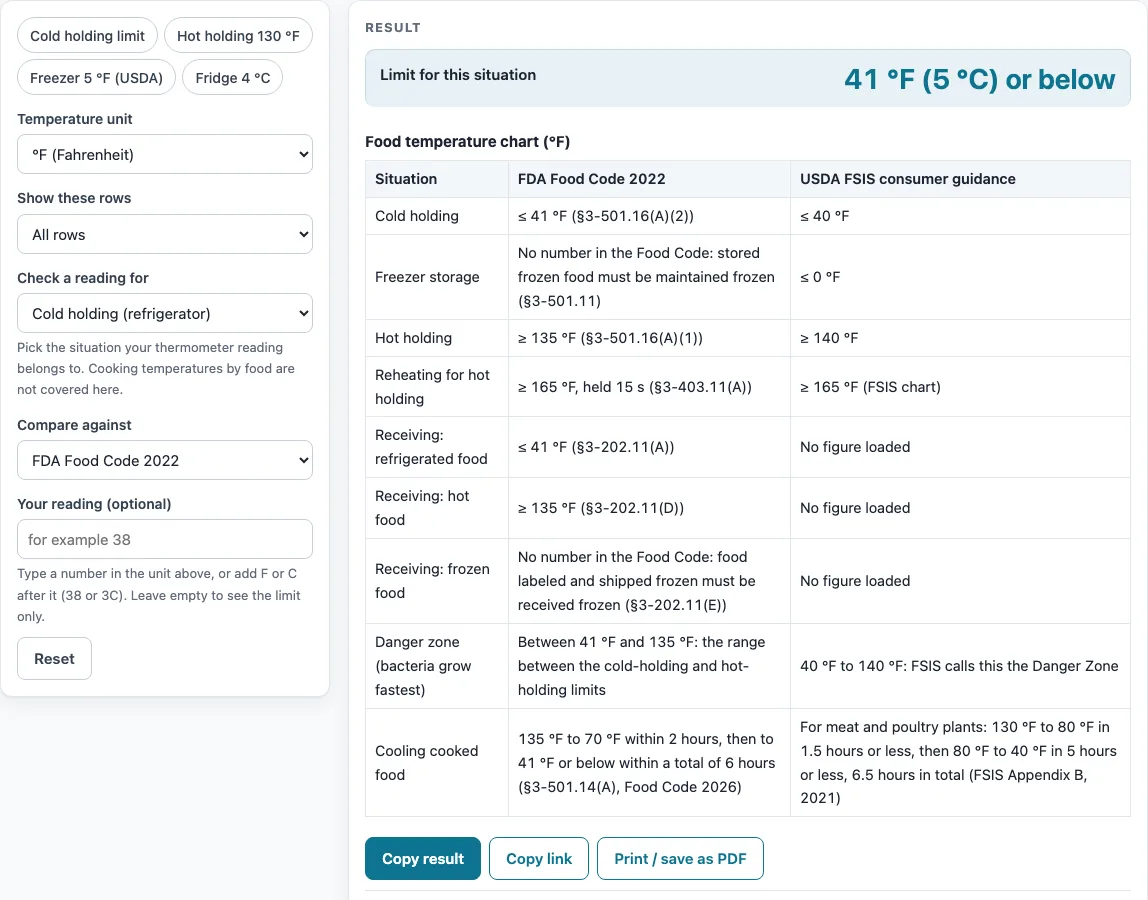
How to use the food temperature chart
- Choose a Temperature unit: °F or °C.
- Under Show these rows, pick All rows or a single group, such as Cold storage and freezer or Receiving deliveries.
- Under Check a reading for, pick the situation, such as Cold holding (refrigerator), Receiving hot food or Freezer storage.
- Under Compare against, pick FDA Food Code 2022 or USDA FSIS consumer guidance. The numbers differ, so choose the one your local rules use.
- Read Limit for this situation. It shows the limit in your chosen unit, for example 41 °F (5 °C) or below.
- Optional: type a reading into Your reading (optional). Enter a plain number in the chosen unit, or add F or C after it, such as 38 or 3C.
- Read Your reading, which says whether the reading is within or outside the limit. If it is outside, follow the text under If the reading is outside the limit.
- Open How it was calculated to see the steps behind the result.
To try the tool quickly, click one of the four chips: Cold holding limit, Hot holding 130 °F, Freezer 5 °F (USDA) or Fridge 4 °C. Each one fills the fields with an example. Reset clears your entries. Copy result copies the result, Copy link copies a link, and Print / save as PDF gives you a printable copy for your records.
What temperature should food be held at
For cold holding, the FDA Food Code 2022 sets 41 °F (5 °C) or below (§3-501.16(A)(2)), and USDA FSIS consumer guidance says 40 °F or below. For hot holding, the Food Code sets 135 °F (57 °C) or above (§3-501.16(A)(1)), and USDA FSIS says 140 °F or above.
Separately, a food business can use time instead of temperature as the control (Food Code §3-501.19): food may be held without temperature control for up to 4 hours, or up to 6 hours if it started at 41 °F or below and never rises above 70 °F. The hot holding and food danger zone pages of this site cover that rule.
In °C, the chart uses the Food Code’s printed values: 5 °C, 21 °C (70 °F) and 57 °C. USDA values are converted from °F, so 40 °F is 4.4 °C and 140 °F is 60 °C. A reading exactly on a limit counts as within it.
What is the temperature danger zone
The danger zone is the range of temperatures between the cold-holding and hot-holding limits, where bacteria can grow quickly. Under the FDA Food Code it runs from 41 °F to 135 °F. USDA FSIS uses 40 °F to 140 °F and calls it the Danger Zone.
Food stays out of the zone when it is kept cold enough or hot enough. The holding limits exist to keep food out of this range.
What temperature should a freezer be
Frozen food should stay frozen. USDA FSIS consumer guidance gives 0 °F or below for best quality. This is a quality figure, not a safety limit.
The FDA Food Code gives no number for freezer storage. Instead, §3-501.11 requires stored frozen food to be maintained frozen. The chart lists both approaches in the Freezer storage row.
What temperature must food be reheated to
For reheating food for hot holding, the FDA Food Code sets 165 °F (74 °C) for 15 seconds (§3-403.11(A)). USDA FSIS consumer guidance also gives 165 °F.
This is the reheating row only. Cooking temperatures for specific foods, such as poultry at 165 °F or ground meat, are not on this chart.
What temperature should refrigerated food be when received
Refrigerated food should arrive at 41 °F (5 °C) or below under FDA Food Code §3-202.11(A). The USDA chart gives no figure for receiving refrigerated food.
Hot food should arrive at 135 °F (57 °C) or above (§3-202.11(D)). Frozen food must arrive frozen, with no number given (§3-202.11(E)).
For example, a walk-in cooler thermometer reading of 38 °F is within the FDA limit of 41 °F, and 42 °F is outside it. In °C, 5 °C is within and 5.1 °C is outside.
Worked examples
| Input | Result |
|---|---|
| Cold holding, FDA Food Code 2022 | 41 °F (5 °C) or below |
| Hot holding, FDA Food Code 2022 | 130 °F is outside the limit (135 °F (57 °C) or above). |
| Freezer storage, USDA FSIS consumer guidance | 5 °F is outside the limit (0 °F (-17.8 °C) or below). |
| Cold holding, FDA Food Code 2022 | 4 °C is within the limit (41 °F (5 °C) or below). |
Calculated by the tool above; open it with the same values to see each step.
Frequently asked questions
Is the food temperature chart free to use?
Yes. It is free, runs in your browser, and nothing you type is uploaded. Results and printouts may be used for any purpose, including commercial use, with no credit needed.
What temperature should my freezer be set at?
USDA FSIS consumer guidance gives 0 °F or below for best quality. That figure is a quality guideline rather than a safety limit, and the FDA Food Code gives no number for freezer storage.
What temperature should a refrigerator be?
USDA FSIS advises keeping a refrigerator no higher than 40 °F. The FDA Food Code cold-holding limit is 41 °F (5 °C) or below. Check the temperature with a thermometer placed inside the unit.
Does the chart show cooking temperatures for meat and poultry?
No. Cooking temperatures by food, such as 165 °F for poultry, are not on this chart. It covers holding, reheating, receiving, freezer storage and cooling.
What is the danger zone temperature range?
The FDA Food Code range runs from 41 °F to 135 °F (5 °C to 57 °C), and USDA FSIS uses 40 °F to 140 °F. The chart shows both in the danger zone row.
Do the rules where I work match this chart?
Not always. Local health departments adopt their own edition of the Food Code and may be stricter, so check with your local regulator before relying on any of these numbers.
Related tools
- Hot holding temperature: use it when you need the hot-holding limits and the time rules that apply alongside them.
- Food danger zone: use it to understand why the range between the cold and hot limits matters.
- Walk-in cooler temperature: use it when you are checking a walk-in cooler’s readings.
- Food temperature log: use it to record temperature readings over time.
- Two-stage cooling method: use it when you need to cool cooked food in two stages.
- Receiving log: use it to record the temperature of deliveries when they arrive.