Food Temperature Log
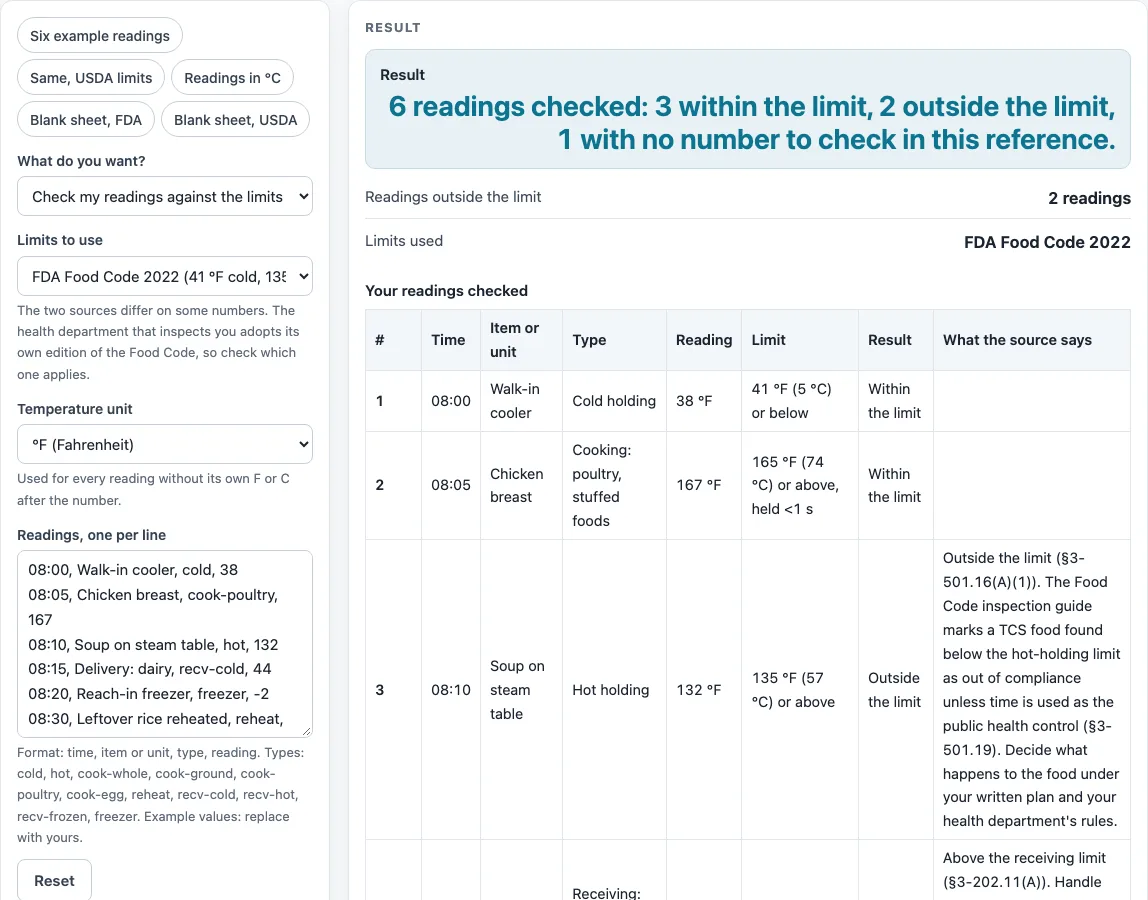
Type your readings, one per line, to see which are within the stated limit and which are outside it, or switch to a blank sheet with the limits printed above each column.
How to use the Food Temperature Log
- Choose a mode. Use check mode to test readings you have already taken, or blank sheet mode to print a log sheet.
- In check mode, choose the reference: the FDA Food Code 2022 or USDA FSIS consumer guidance.
- Set the unit in the form to °F or °C. Readings typed without a letter use this unit.
- Type one reading per line as four parts: time, item or unit, type, reading. For example:
11:30, soup, hot, 132. - Pick one of the 11 types for each line: cold, hot, cook-whole, cook-ground, cook-poultry, cook-egg, reheat, recv-cold, recv-hot, recv-frozen or freezer.
- To enter a Celsius reading, add C after the number, such as
57C. - Run the check. Each row shows “Within the limit”, “Outside the limit” or “No number to check”.
- For an outside reading, read the wording of the cited source shown beside it.
- Fix any errors before you continue. The page reports an error for no lines, a line without four parts, an unknown type, or a reading that is not a number. It shows a warning for a reading below -60 °F or above 500 °F, and for more than 200 lines.
- For a blank sheet, choose 1 to 60 rows (the default is 20), keep or drop the initials column, and print. The limits appear in the column headings, such as “Cold holding (≤ 41 °F)”.
You can download the tables as a CSV file or print the page through your browser’s print option.
What is a food temperature log for?
A food temperature log records the temperature of food at set points, so you can see whether food stayed within the stated limits over a shift or a day. The log only helps if each reading is compared with a fixed limit and the result is written down. This tool does that comparison for each line you type.
Which limits does the tool check?
The tool checks the limits in the reference you choose. Under the FDA Food Code, cold holding is 41 °F (5 °C) or below, and hot holding is 135 °F (57 °C) or above. Receiving refrigerated food is checked at 41 °F or below, and receiving hot food at 135 °F or above. Reheating is checked at 165 °F (74 °C) held for 15 seconds. Cooking limits are 145 °F (63 °C) for fish, intact meat and eggs broken to order, 155 °F (68 °C) for ground or non-intact meat and for eggs not broken to order, and 165 °F (74 °C) for poultry and stuffed foods. The Food Code cooking row for holding time is printed but not checked.
Why do FDA and USDA limits differ?
The two references set some limits at different numbers. Cold holding is 41 °F under the FDA Food Code but 40 °F under USDA appliance guidance, so a reading of 41 °F is within the limit under FDA and outside it under USDA. Hot holding is 135 °F under the Food Code and 140 °F under USDA. Eggs not broken to order use 155 °F in the Food Code row and 160 °F in USDA guidance. The page shows both sets of numbers, named. The USDA FSIS figures were read from search excerpts of its pages, because the pages did not load for our check. Your local health department’s adopted code decides which one applies to you.
How are Celsius readings compared?
A reading typed in °C is compared with the limit’s own °C value. The Food Code lists 57 °C beside 135 °F, so 57 °C counts as within the hot-holding limit. The tool does not convert between units for you; it uses the value printed for that limit.
What does “No number to check” mean?
The Food Code gives no number for freezers or for food received frozen. It says stored frozen food is kept frozen, and food labeled and shipped frozen is received frozen. Under the FDA reference, the freezer and recv-frozen types therefore show “No number to check.” USDA guidance gives a freezer limit of 0 °F or below, so those rows are checked under USDA.
Sources (checked 15 October 2026): fda.gov · fsis.usda.gov · fsis.usda.gov · fsis.usda.gov
Worked examples
| Input | Result |
|---|---|
| 6 readings against FDA Food Code 2022 | 3 within, 2 outside, 1 without a number |
| 3 readings against USDA FSIS consumer guidance | 2 within, 1 outside, 0 without a number |
| 3 readings against FDA Food Code 2022 | 2 within, 1 outside, 0 without a number |
| blank sheet, 20 rows | 10 columns with limits in the headings |
| blank sheet, 12 rows | 9 columns with limits in the headings |
Calculated by the tool above; open it with the same values to see each step.
Frequently asked questions
Is a “Within the limit” result a ruling on my kitchen?
No. The tool compares one reading with one limit. It does not judge your food, your kitchen or your procedures, and it never rates a food or a kitchen. Your local health department decides how its own code applies.
What does an “Outside the limit” result tell me?
It means the reading is past the limit in the reference you chose. For these rows, the tool shows the wording of the cited source. For example, the Food Code inspection guide marks a TCS food found out of temperature as out of compliance unless time is the public health control.
Can I print a blank log sheet?
Yes. Choose blank sheet mode, pick between 1 and 60 rows (the default is 20), and print through your browser. The limits are printed in the column headings, so staff can see them while they record readings.
Is my data uploaded anywhere?
No. Everything runs in your browser, and nothing you type is uploaded. You do not need to sign up.
Why does a 41 °F reading show different results?
The FDA Food Code allows 41 °F for cold holding, while USDA guidance uses 40 °F. The same reading can therefore be within one limit and outside the other. Choose the reference that matches the code your health department uses.
Can I use this log for a restaurant temperature log?
Yes. Type your readings in check mode, or print a blank sheet with the columns for cold holding, hot holding, cooking, reheating, receiving and freezer.
Related tools
Food Temperatures, Holding and Cooling: Use it to see every food temperature page on this site in one place.
Cold Chain Monitoring: Logger CSV to Printable Report: Use it when you have logger data files and need a printable report.
Food Danger Zone Time Calculator: Use it to work out how long food has spent between temperatures that allow bacteria to grow.
Hot Holding Temperature Checker: Use it to check whether a hot food reading is within the limit you choose.
How Long Can Food Sit Out?: Use it to estimate how long food can stay at room temperature.
TCS Food List: Use it to see which foods are time and temperature controlled for safety.
Two-Stage Cooling Method Checker: Use it to check cooling steps for cooked food.
Vaccine Temperature Log: Use it to keep a temperature record for vaccine storage.
Walk-In Cooler and Freezer Temperature Log: Use it to record temperatures for walk-in coolers and freezers.