HACCP Plan Example
Pick a sample menu item to see a complete HACCP plan with flow steps, hazard analysis, CCP limits from the FDA Food Code and a plain-words summary. Each one is an example to edit for your own menu.
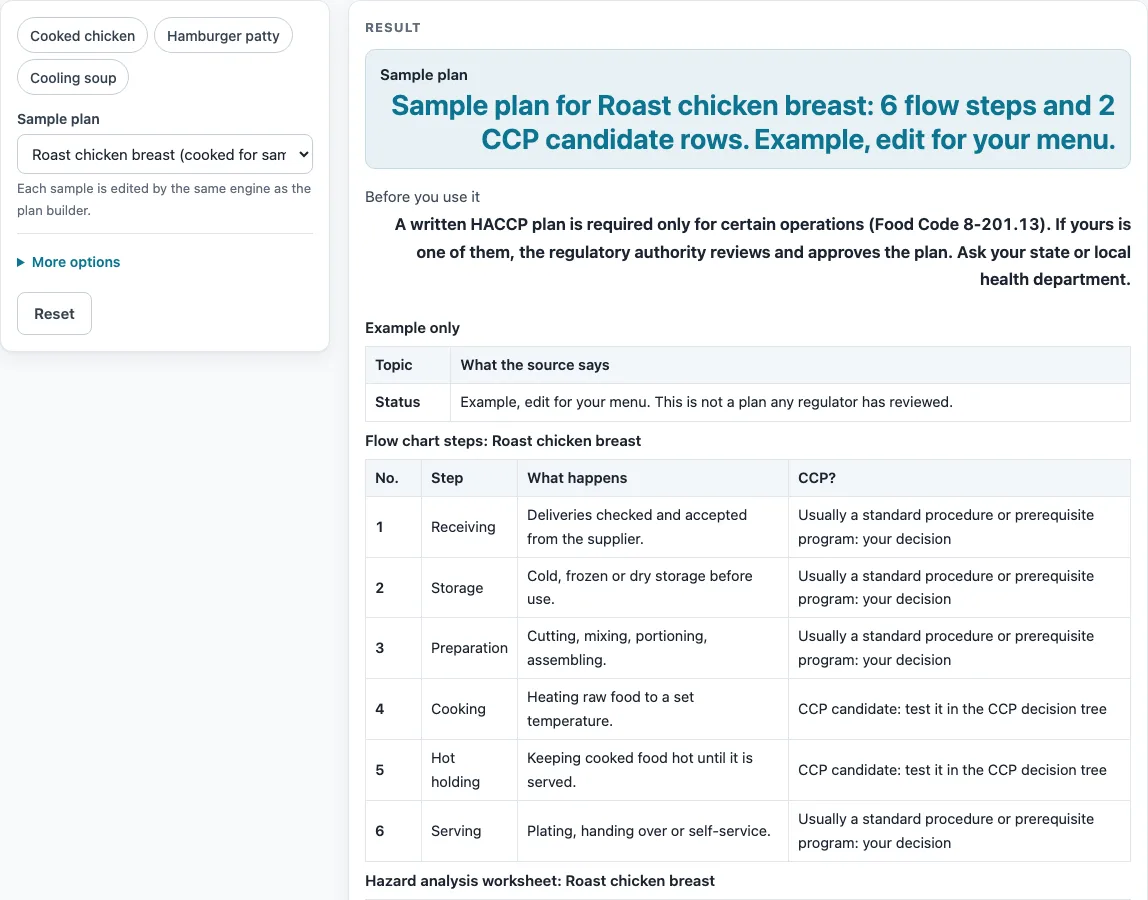
How to use the HACCP Plan Example
- Under “Sample plan”, pick one of the three samples: roast chicken breast, hamburger patty, or vegetable soup. You can also start from a preset: cooked chicken, hamburger patty, or cooling soup.
- Read the first table, which is labelled “Example, edit for your menu”. Treat every row as a draft.
- Check the flow chart steps table. The chicken sample has 6 steps and the soup sample has 8.
- Review the hazard analysis worksheet. Each step lists its hazards, and the hygiene row can be turned on or off with “Include hygiene and cross-contamination row”.
- Look at the CCP summary to see which steps are critical control points in that sample.
- Tick or untick “Add the plain-words table”. It has four rows per sample: why the step is a CCP candidate, the limit, what to do when the limit is missed, and what to write down.
- Edit the steps, hazards, limits and corrective actions so they match your equipment and menu.
- Read the notes table at the end for when a written plan goes to the regulator and how often to monitor.
Tables can be printed or downloaded as CSV. Nothing is uploaded. Chemical and physical hazard rows are included in every sample, and the blank hazard rows are left out.
What makes a step a critical control point?
A critical control point (CCP) is a step where a hazard can be prevented, eliminated or reduced to an acceptable level, and where a control must be applied. In the samples, the cooking, cooling, reheating and hot holding steps are the CCP candidates. The samples do not include a decision tree, so check the CCP page before you decide which of your own steps are CCPs.
What limits do the sample plans use?
The limits are the values stated by the FDA Food Code, which the samples name by section. For the chicken sample, the cooking limit is 165 °F (74 °C) for less than 1 second (Food Code 3-401.11(A)(3)), and hot holding is at 135 °F (57 °C) or above (3-501.16(A)(1)). For the hamburger patty, cooking is 155 °F (68 °C) for 17 seconds, or another time-temperature pair from 3-401.11(A)(2).
How do cooling and reheating limits work in the soup sample?
Cooling has two deadlines. The soup must cool from 135 °F to 70 °F within 2 hours, and from 135 °F to 41 °F within 6 hours total (3-501.14(A)). Reheating must bring the food to 165 °F for 15 seconds within 2 hours (3-403.11). The soup sample also cooks plant food for hot holding to 135 °F (57 °C) (3-401.13).
What is a corrective action, and why write it down?
A corrective action is what you do when a limit is missed. The hamburger sample quotes the Annex 4 example of continuing to cook hamburgers that have not reached 155 °F for 17 seconds. Writing down the result, the action taken and who took it gives you a record that shows the control was checked. The plain-words table in each sample repeats this in four rows, so you can see why a step is a candidate, what its limit is, what to do when the limit is missed and what to record. Treat the wording as a starting draft and replace it with your own procedure.
Which Food Code edition does the plan use?
The FDA lists the 2026 Food Code as the most recent full edition. The sections used in these samples are identical in the 2022 edition. States adopt their own edition, so the code your local health department has adopted governs your plan. That code may be stricter than the values shown here.
Sources (checked 15 October 2026): fda.gov · fda.gov · fda.gov · fda.gov
Worked examples
| Input | Result |
|---|---|
| A 6-step worksheet | Sample plan for Roast chicken breast: 6 flow steps and 2 CCP candidate rows. Example, edit for your menu. |
| A 6-step worksheet | Sample plan for Hamburger patty: 6 flow steps and 2 CCP candidate rows. Example, edit for your menu. |
| A 8-step worksheet | Sample plan for Vegetable soup, cooked, cooled and reheated: 8 flow steps and 4 CCP candidate rows. Example, edit for your menu. |
| A 6-step worksheet | Sample plan for Roast chicken breast: 6 flow steps and 2 CCP candidate rows. Example, edit for your menu. |
Calculated by the tool above; open it with the same values to see each step.
Frequently asked questions
Is this haccp plan example ready to use in my kitchen?
No. The samples are not plans that any regulator has reviewed. Edit the steps, hazards and limits for your own menu before you use them.
Where do the sample flows come from?
The sample flows are the Annex 4 “Process 2” and “Process 3” example flows. Chicken is a same-day service process, and the soup is a cooked, cooled and reheated process.
Does the tool upload my plan?
No. The tool runs in your browser and nothing is uploaded. It is free and needs no sign-up.
Can I print or export the tables?
Yes. Tables can be printed or downloaded as CSV.
Which sample should I start with?
Start with the sample closest to your menu. If you cook and serve a single item the same day, the chicken or hamburger patty sample is a good base. If you cook food in advance, cool it and reheat it, start with the soup sample.
Which limits does the hamburger sample use?
Cooking is 155 °F (68 °C) for 17 seconds, or one of the other time and temperature pairs in 3-401.11(A)(2): 145 °F for 3 minutes, 150 °F for 1 minute, or 158 °F instantly. Hot holding is 135 °F (57 °C) or above. Your local health department adopts its own Food Code edition and may be stricter.
Why is the soup a plant food sample?
The cooking limit for meat soups depends on the ingredients, so the sample uses a vegetable soup, cooked to 135 °F (57 °C) for hot holding under 3-401.13. A meat-based soup is not shown, so look up the limit for your own ingredients.
Related tools
- HACCP Plans and Critical Control Points: use this to see every HACCP page on this site in one place.
- Critical Control Points: CCP Decision Tree: use this when you need to decide whether a step is a CCP.
- HACCP Plan for a Restaurant: use this when you are writing a plan for a restaurant kitchen.
- HACCP Plan Template: use this when you want a blank layout to fill in by hand.
- What Is a HACCP Plan?: use this when you need the basic definition and parts of a plan.
- When Is a HACCP Plan Required?: use this when you are not sure whether your operation needs a plan.
- Two Stage Cooling Method: 2-Hour and 6-Hour Cooling Deadlines and Log: use this to check the cooling deadlines used in the soup sample.
- Food Temperatures, Holding and Cooling: use this for the hot holding and cold holding pages behind the sample limits.