HACCP Plan for a Restaurant
Pick how a menu item is prepared and what is cooked. You get the flow chart steps, a hazard analysis worksheet and a critical control point summary with Food Code limits, ready to edit, print or download.
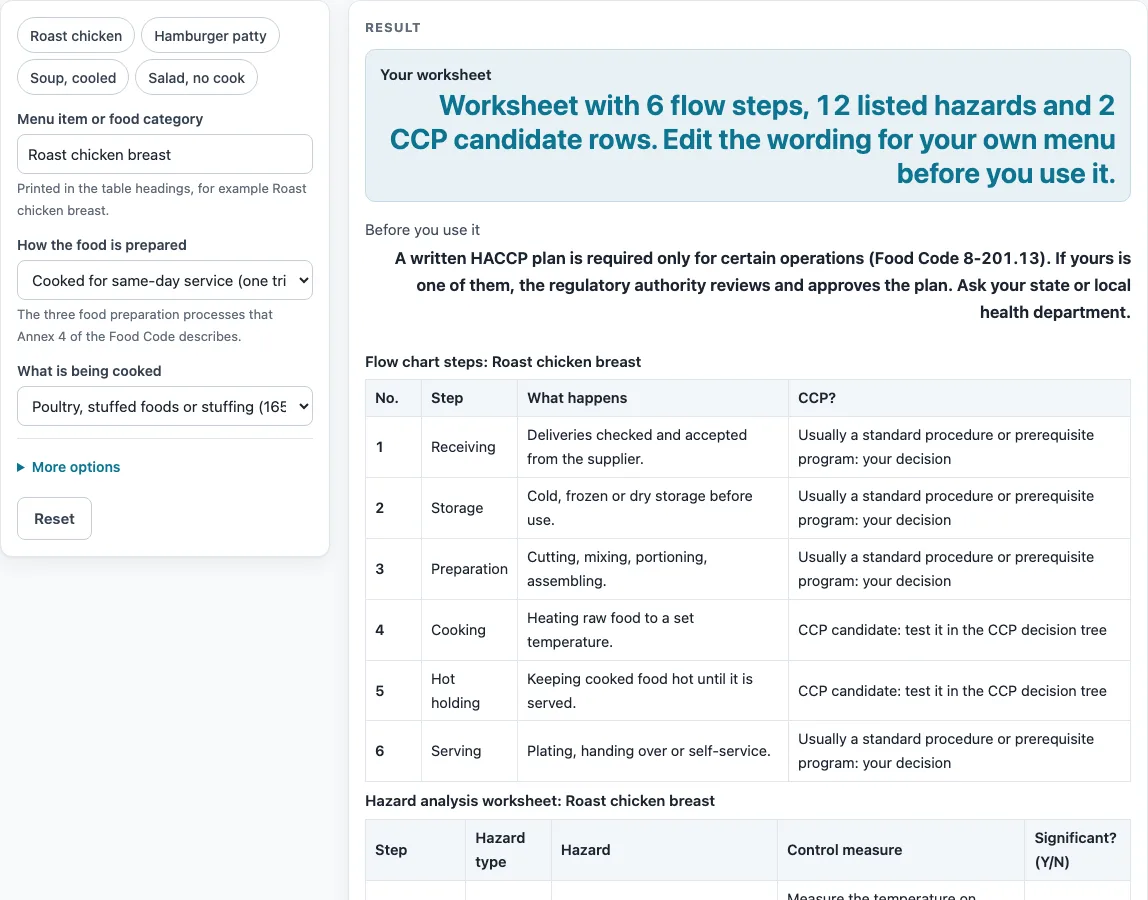
How to use the HACCP Plan Worksheet
- Choose “How the food is prepared”: no cook step, cooked for same-day service, or cooked, cooled and reheated. These follow the process types in Food Code Annex 4.
- If it appears, choose “What is being cooked”. It is hidden for the no-cook process. It sets the cooking critical limit, such as 165 °F (74 °C) for poultry.
- Enter the extra blank hazard rows, from 0 to 12 (default 3). Values above 12 are capped at 12 with a warning. A non-number causes an error.
- Read the flow chart steps table in order.
- Check the rows marked as CCP candidates. Cooking, cooling, hot holding, cold holding of ready-to-eat food and reheating are marked. Other steps are marked as usually a standard procedure or prerequisite program.
- Work through the hazard analysis worksheet. For each hazard, read its control measure, then fill in the “Significant? (Y/N)” column yourself.
- Complete the monitoring, corrective action, verification and record columns. Who monitors and how often are left for you.
- Add your own details in the notes table.
- Print the tables or download them as a CSV file.
Tick the boxes to add chemical hazards, physical hazards or the all-steps hygiene and cross-contamination row. Presets for roast chicken, hamburger patty, soup cooled and salad with no cook step give you a starting setup to change as needed.
What does a haccp plan for restaurant record at each step?
A haccp plan for restaurant records each step in one food’s path, from receiving to serving, along with the hazards that could arise there and the control for each. The steps you see depend on whether the food is cooked, cooled or reheated, because the worksheet follows the process types in Food Code Annex 4.
The main hazards are biological. The examples on the page come from Annex 4: Salmonella and Campylobacter for poultry, Salmonella and E. coli O157:H7 for a ground beef product, Clostridium perfringens and Bacillus cereus for hot holding and cooling, and Listeria monocytogenes for ready-to-eat food held cold.
Each hazard is linked to monitoring, a corrective action, verification and a record. The cooking corrective action follows the Annex 4 example: keep cooking hamburgers that have not reached 155 °F for 17 seconds. Monitoring is the check that the control is working, so it needs a named person and a set frequency that you decide.
Which steps become critical control points?
Annex 4 names cooking, cooling, hot holding and cold holding of ready-to-eat TCS food as common critical control points. Reheating is also marked as a candidate. Other steps are marked as usually a standard procedure or prerequisite program, and you decide whether each one is a CCP. The decision tree on the CCP page, attributed to the NACMCF in a UF/IFAS Extension publication, can help with that decision.
The critical limits shown come from the FDA Food Code:
- Cooking: poultry and stuffed foods 165 °F (74 °C) for less than 1 second; ground or non-intact meat 155 °F (68 °C) for 17 seconds; intact meat, fish and eggs to order 145 °F (63 °C) for 15 seconds; plant food for hot holding 135 °F (57 °C).
- Cooling: from 135 °F to 70 °F within 2 hours, and to 41 °F within a total of 6 hours (3-501.14(A)).
- Reheating: 165 °F for 15 seconds within 2 hours (3-403.11).
- Hot holding: 135 °F or above (3-501.16(A)(1)).
- Cold holding: 41 °F or below (3-501.16(A)(2)).
When does a restaurant haccp plan go to the regulator?
The notes table says a HACCP plan goes to the regulatory authority for approval only in the cases listed in Food Code 8-201.13. It also says Annex 4 describes HACCP at retail as generally voluntary. FDA lists the 2026 Food Code as the most recent full edition, and the sections used here are identical in the 2022 edition. Your local health department adopts its own edition, which governs your business and may be stricter.
Sources (checked 15 October 2026): fda.gov · fda.gov · fda.gov · fda.gov
Worked examples
| Input | Result |
|---|---|
| A 6-step worksheet | Worksheet with 6 flow steps, 12 listed hazards and 2 CCP candidate rows. Edit the wording for your own menu before you use it. |
| A 8-step worksheet | Worksheet with 8 flow steps, 14 listed hazards and 4 CCP candidate rows. Edit the wording for your own menu before you use it. |
| A 5-step worksheet | Worksheet with 5 flow steps, 9 listed hazards and 1 CCP candidate rows. Edit the wording for your own menu before you use it. |
| A 6-step worksheet | Worksheet with 6 flow steps, 8 listed hazards and 2 CCP candidate rows. Edit the wording for your own menu before you use it. |
Calculated by the tool above; open it with the same values to see each step.
Frequently asked questions
Is a haccp plan for restaurant required?
The notes table says a HACCP plan goes to the regulatory authority for approval only in the cases listed in Food Code 8-201.13. It also says Annex 4 describes HACCP at retail as generally voluntary. Your local health department decides how its adopted code applies to your business.
Which Food Code edition does this page use?
FDA lists the 2026 Food Code as the most recent full edition, and the sections used here are identical in the 2022 edition. Your local regulator’s adopted code governs, and it may be stricter than the limits shown.
Does the tool keep my worksheet?
Nothing is uploaded. The tool runs in your browser and needs no sign-up. Print the tables or download them as a CSV file to keep a copy.
Who fills in the monitoring columns?
The monitoring, corrective action, verification and record columns repeat what Annex 4 says. Who monitors and how often are left for you, so assign a named person and a set frequency in your own plan.
Which hazards does the worksheet list?
Biological hazards are listed for each step. Tick boxes add chemical hazards (cleaners, sanitizers, shellfish toxins), physical hazards (glass, metal, plastic, personal effects) and the all-steps hygiene and cross-contamination row. Mark each hazard in the “Significant? (Y/N)” column yourself.
Why does the cooking limit change?
The limit depends on the food. Poultry is 165 °F (74 °C) for less than 1 second, and ground meat is 155 °F (68 °C) for 17 seconds. Choose the item under “What is being cooked” to match the limit to your menu item.
Related tools
- HACCP Plans and Critical Control Points: use it to see every HACCP page on this site in one place.
- Critical Control Points: CCP Decision Tree: use it to work through whether a step is a CCP.
- HACCP Plan Example: use it to see a completed plan before you fill in your own.
- HACCP Plan Template: use it when you want a blank layout to write your plan on.
- What Is a HACCP Plan?: use it to learn the basic terms before you start.
- When Is a HACCP Plan Required?: use it to check which cases lead to a plan going to the regulator.
- Food Temperatures, Holding and Cooling: use it for the hot holding, cold holding and cooling pages behind the CCP limits.
- Kitchen Checklists and Logs: use it for the logs that hold your monitoring records.