HACCP Plan Template
Choose how many flow steps, hazard rows and CCP rows you need and which columns to keep. The blank template follows the contents list in Food Code 8-201.14; print it or download it as CSV for Excel or Word.
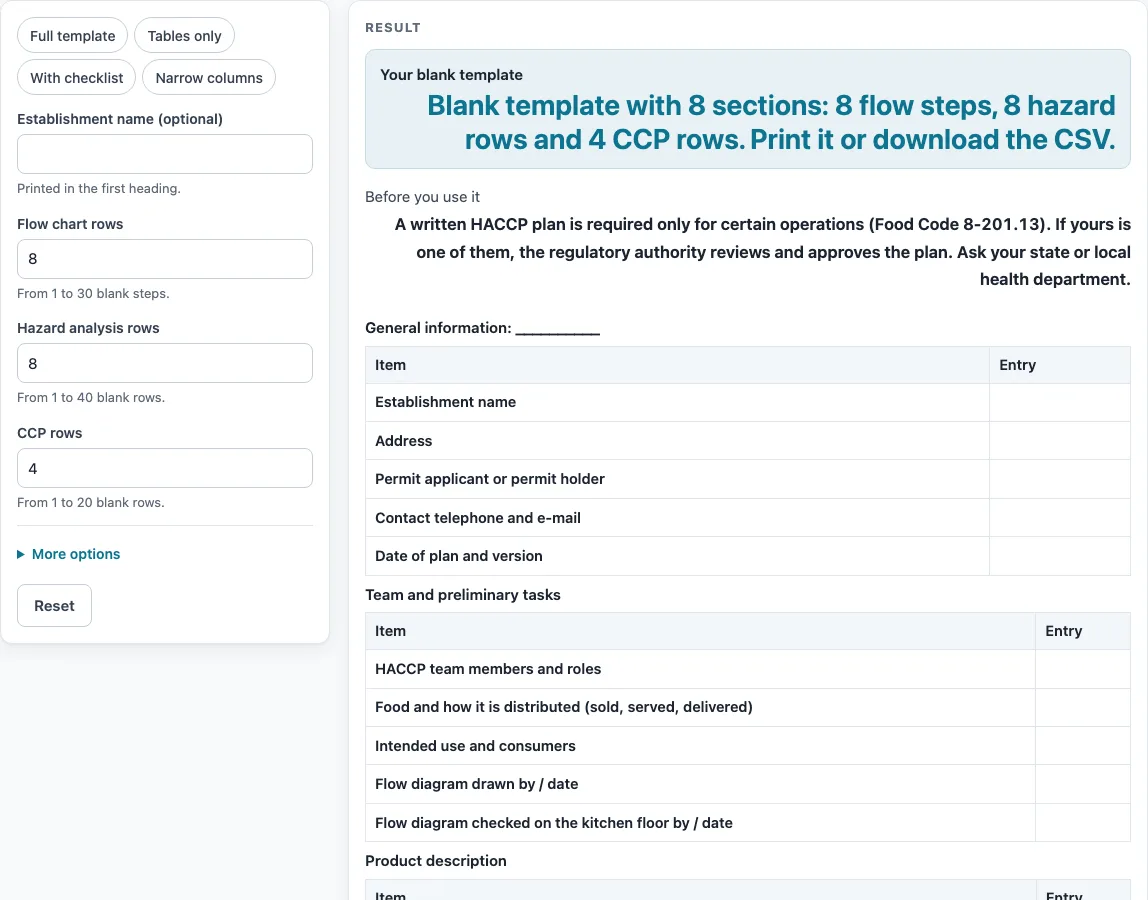
How to use the HACCP Plan Template
- Type your establishment name in the name field. It prints in the first heading. If you leave it empty, the heading shows a blank line.
- Set the number of flow chart rows, from 1 to 30. The default is 8.
- Set the hazard rows, from 1 to 40 (default 8), and the CCP rows, from 1 to 20 (default 4).
- Turn sections on or off with the switches: general information, team block, product description, intended use, hazard type column, the CCP table columns for monitoring, corrective action, and verification and records, and the record types table.
- Leave the 8-201.14 contents checklist off unless you need it. It is off by default.
- Check for errors. A row count that is not a number, or is below 1, is flagged. A count above the limit is capped and you see a warning.
- Choose a preset: full template, tables only, with checklist, or narrow columns.
- Review the tables. Flow chart rows are numbered 1 to N, and CCP rows are labelled CCP 1 to CCP N.
- Print the page, or download the CSV, which holds all sections one after another. The CSV opens in Excel. For a Word file, paste the printed version into Word.
Presets save you from setting each switch by hand, and you can change any switch after picking one. The printed version keeps the tables as they are on screen, so check the row counts before you print.
What is a HACCP plan template?
A HACCP plan template is a set of empty tables that organizes the written parts of a HACCP plan. It gives you a place to record your general information, your team, your product, the steps in your process, the hazards at each step, and the controls you apply. The template in this tool is blank, so it contains no limits or temperatures. You supply those values for your own operation.
Which sections does the template include?
The template includes general information, a team and preliminary tasks block, a product description, intended use and consumers, a flow diagram steps table, a hazard analysis table, a CCP table with monitoring, corrective actions, verification and records, a record types table, and an optional 8-201.14 contents checklist. The order follows Food Code 8-201.14 (A) to (G) and the NACMCF preliminary tasks. The team block lists five preliminary tasks as rows: team and roles, food and distribution, intended use and consumers, flow diagram drawn, and flow diagram checked.
How is the hazard analysis table filled in?
The hazard table has columns for step, hazard type (optional), hazard, significant?, and control measure. You list each process step in the step column, then name any hazard at that step. The “significant?” column records whether the hazard is significant for your operation. The “control measure” column records what you do to control it. You can turn the hazard type column off.
What are critical control points in this template?
A critical control point (CCP) is a step where a control can be applied to prevent, eliminate or reduce a hazard. The CCP table labels each row CCP 1 to CCP N. The template itself holds no decision tree; to test whether a step is a CCP, use the CCP page linked below.
Which Food Code rules does the contents checklist follow?
The contents checklist has seven rows, one for each item (A) to (G) of Food Code 8-201.14. Each row carries its section reference, so you can check that your written plan covers each item. The sections used here are the same in the 2022 edition of the Food Code. The 2026 edition is the most recent full edition listed by FDA. Your state or local health department adopts its own edition, and that adopted code governs. The local code may be stricter than the FDA Food Code, so check it before you rely on the checklist.
Which records does a HACCP plan need?
The record types table lists five record types from Annex 4: prerequisite programs, monitoring, corrective action, verification and validation, and calibration records. For each type, the table has columns for the form used, the person who keeps it, and where and how long it is stored.
Sources (checked 15 October 2026): fda.gov · fda.gov · fda.gov · fda.gov
Worked examples
| Input | Result |
|---|---|
| A blank template with 8 flow steps | Blank template with 8 sections: 8 flow steps, 8 hazard rows and 4 CCP rows. Print it or download the CSV. |
| A blank template with 10 flow steps | Blank template with 9 sections: 10 flow steps, 12 hazard rows and 5 CCP rows. Print it or download the CSV. |
| A blank template with 8 flow steps | Blank template with 3 sections: 8 flow steps, 8 hazard rows and 4 CCP rows. Print it or download the CSV. |
| A blank template with 6 flow steps | Blank template with 8 sections: 6 flow steps, 8 hazard rows and 4 CCP rows. Print it or download the CSV. |
Calculated by the tool above; open it with the same values to see each step.
Frequently asked questions
Is this HACCP plan template free to use?
Yes. The tool is free, needs no sign-up, and runs in your browser. Nothing you type is uploaded.
Can I open the template in Word?
Yes. Print the page and paste the printed version into Word. You can also download the CSV, which holds all sections one after another and opens in Excel.
Does the template include food safety limits or temperatures?
No. The template is blank, so no limits or temperatures are printed. Limits come from the FDA Food Code or USDA guidance, as your local regulator adopts them. Your health department may be stricter, so check your local code.
Do I need a written HACCP plan?
A written HACCP plan is required only for certain operations. Your regulatory authority reviews and approves the plan you write, so check with them about your own situation.
Which Food Code edition does the template follow?
The sections used here are identical in the 2022 edition of the Food Code. The 2026 edition is the most recent full edition listed by FDA. Your state or local health department adopts its own edition, which governs your operation.
How many rows can I add?
You can set 1 to 30 flow chart rows, 1 to 40 hazard rows, and 1 to 20 CCP rows. If you enter a number above a limit, the count is capped and a warning appears. A count that is not a number, or is below 1, is flagged as an error.
What if I want a sample filled in?
This page shows a blank template only. For a filled-in example, see the HACCP plan example page linked below.
Related tools
- HACCP Plans and Critical Control Points: Use this to see every HACCP page on this site in one place.
- Critical Control Points: CCP Decision Tree: Use this when you need to work through the questions that decide whether a step is a CCP.
- HACCP Plan Example: Use this when you want to see how a completed plan looks before you fill in your own.
- HACCP Plan for a Restaurant: Use this when your operation is a restaurant and you want guidance for that setting.
- What Is a HACCP Plan?: Use this when you want a plain explanation of what a HACCP plan covers before you start.
- When Is a HACCP Plan Required?: Use this when you need to check whether a written plan applies to your operation.
- Kitchen Checklists and Logs: Use this to find the logs that can serve as your monitoring and corrective action records.