How Long Can Food Sit Out?
Enter how long the food has been out, the air temperature and the rule you follow to get the time left and the clock time the limit ends.
This free tool shows how long can food sit out before a limit is reached, based on the rule you pick: USDA FSIS or the FDA Food Code time limits. It runs in your browser and needs no sign-up.
You enter the food type, the air temperature for USDA checks, the time the food has already been out, and optionally the current time. The result shows the time left before the limit, the clock time the limit ends, or how far past the limit the food is.
USDA FSIS consumer guidance sets the limit at 2 hours for perishable food left at room temperature, and 1 hour above 90 °F. The FDA Food Code allows up to 4 hours, or up to 6 hours for cold food, when a food business uses time as its written public health control. Your local health department adopts its own code edition and may be stricter.
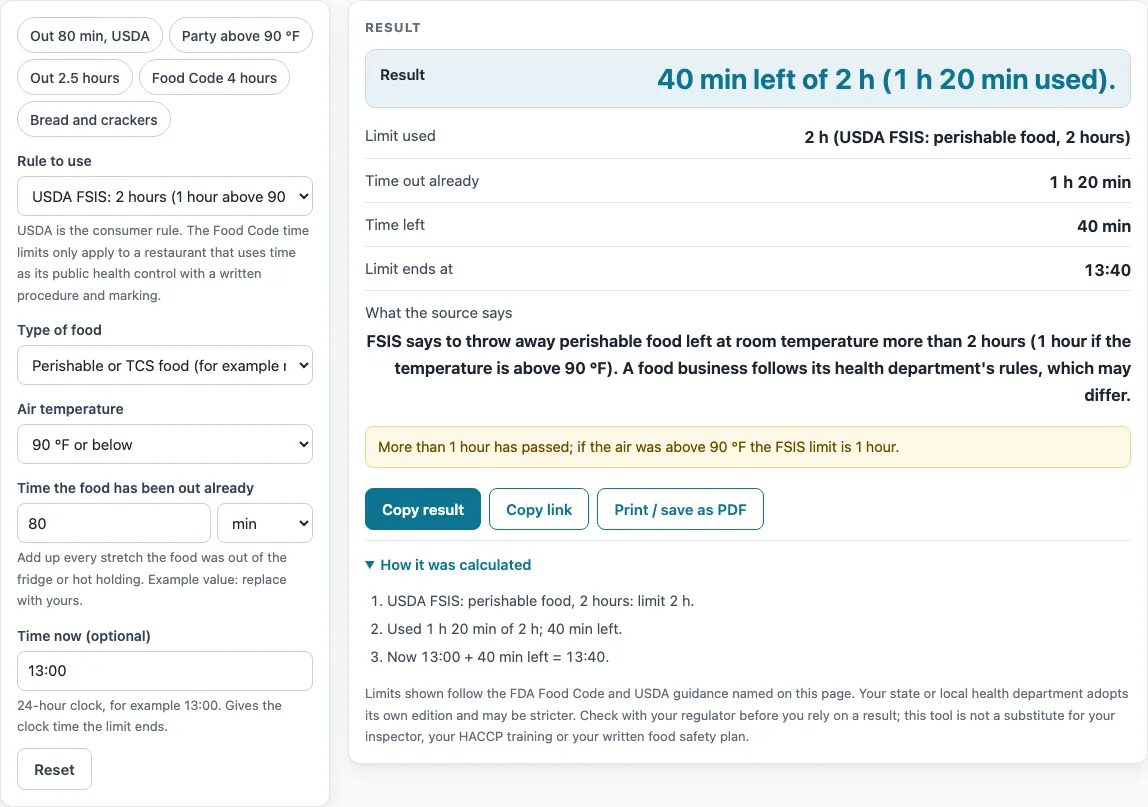
How to use the food sit-out timer
- Choose the “rule”. Pick USDA FSIS for consumer guidance, or a Food Code option for a food business that uses time as its written public health control.
- Choose the type of food. If it is cookies, crackers, bread or whole fruit, the page shows a statement instead of a clock. With a Food Code option, the page points you to the TCS food list.
- For USDA only, enter the air temperature in degrees Fahrenheit. The limit drops to 1 hour when the air is above 90 °F.
- Enter the time already out, in minutes or hours. The value must be a number, not negative, and no more than 24 hours.
- Optionally, enter the time now as a clock time, such as 13:00. The page adds the time left to it and shows the clock time the limit ends, going past midnight when needed.
- Read the result. “N min left of the limit” means time remains. “The limit is reached: nothing left” means the limit has just been reached. “Over the limit by N min” appears with the source’s wording to throw away or discard.
- Watch for the warning. Under USDA with air at 90 °F or below, it appears at 61 to 120 minutes, because the limit is 1 hour if the air was above 90 °F.
For example, with the defaults (USDA, perishable food, air at 90 °F or below, 80 minutes out, time now 13:00), the result is 40 min left of the 2-hour limit, ending at 13:40.
How long can food sit out under the USDA rule?
Under USDA FSIS consumer guidance, perishable food left at room temperature for more than 2 hours should be thrown away. If the temperature is above 90 °F, the limit drops to 1 hour. The page applies this limit by subtracting the time already out from the limit.
The formula is simple: time left equals the limit minus the time already out. If you also enter the time now, the page adds the time left to that clock time to show when the limit ends. For example, 45 minutes out above 90 °F leaves 15 minutes of the 1-hour limit. Sixty minutes out leaves nothing, and 61 minutes is over the limit by 1 minute. Under the 2-hour USDA limit, 2.5 hours out means the food is over by 30 minutes.
The limit counts total time out, which is why the form asks you to add up every stretch the food was out of the fridge or hot holding.
Why do the USDA and FDA Food Code limits differ?
The two sources cover different settings, so they set different limits. USDA FSIS guidance is written for consumers. The FDA Food Code is used by food businesses, and it allows time to be used as a public health control instead of temperature alone.
Under the Food Code, food may stay out up to 4 hours if it starts at 41 °F or below, or at 135 °F or above. Cold food that starts at 41 °F or below and stays at or below 70 °F may stay out up to 6 hours. Both options need a written procedure and time marking (§3-501.19). With the 4-hour limit, 3 hours out leaves 1 hour. With the 6-hour limit, 5 hours 30 minutes out leaves 30 minutes.
The page names which rule it applies, so read the result against the rule you selected. The USDA FSIS figures and its exception list were read from search excerpts of its pages, which did not load for our check. Your local health department adopts its own edition of the Food Code and may set stricter requirements.
Sources (checked 15 October 2026): fsis.usda.gov · fda.gov · fsis.usda.gov · fsis.usda.gov
Worked examples
| Input | Result |
|---|---|
| out 80 min, USDA FSIS: 2 hours (1 hour above 90 °F) | 40 min |
| out 45 min, USDA FSIS: 2 hours (1 hour above 90 °F) | 15 min |
| out 2.5 h, USDA FSIS: 2 hours (1 hour above 90 °F) | Over by 30 min |
| out 3 h, FDA Food Code: 4 hours as the control | 1 h |
| out 80 min, USDA FSIS: 2 hours (1 hour above 90 °F) | No clock for this food type |
Calculated by the tool above; open it with the same values to see each step.
Frequently asked questions
What happens when the limit is reached?
The result shows “the limit is reached: nothing left.” Food at that point has used up the time allowed by the rule you chose. The page does not add any further time.
Does the 61 to 120 minute warning rate my food?
The warning marks the range where the USDA FSIS 1-hour limit may apply, which happens when the air was above 90 °F. It makes no claim about the food itself.
Can I enter the time out in hours?
Yes. Enter the time already out in minutes or hours. The value must be a number, not negative, and no more than 24 hours.
Why does the page reject my time now?
The time now must be a clock time, such as 13:00. If it is not, the page shows an error instead of an end time. You can leave it blank and still get the time left.
Which foods get a statement instead of a clock?
Under the USDA rule, cookies, crackers, bread and whole fruit are on the FSIS exception list. The page shows a statement for these foods instead of a time limit. For Food Code options, the TCS food list is the reference.
Does this tool replace my local health department’s rules?
No. The page shows the limits stated by USDA FSIS consumer guidance and the FDA Food Code. Your local health department adopts its own code edition and may be stricter.
Related tools
Food Temperatures, Holding and Cooling: use it to see every food temperature page on this site in one place.
Food Danger Zone Time Calculator: use it to check time spent between 41 °F and 135 °F.
TCS Food List: use it to see which foods are time/temperature control for safety foods.
Hot Holding Temperature Checker: use it when food is kept hot and you need to check its temperature.
Food Temperature Log: use it to record food temperatures over a shift.
Two-Stage Cooling Method Checker: use it when cooked food must be cooled in two stages.
Walk-In Cooler and Freezer Temperature Log: use it to record readings for walk-in cooler and freezer units over time.
Cold Chain Monitoring: Logger CSV to Printable Report: use it when you have logger data files and need a printable report.