How Long Does Dry Ice Last?
Enter how much dry ice you have. You get the shortest and longest time it lasts at the published loss rate, with the safety points for using it.
This page answers how long does dry ice last with a free calculator that runs in your browser. Enter an amount of dry ice and choose a loss rate, and the tool shows the time as a range in hours and days.
Dry ice turns from solid to gas over time, so the amount you have sets how long it lasts. In a typical storage cooler, it loses about 5 to 10 pounds every 24 hours, so a 10 lb block can last roughly 1 to 2 days. The published range comes from a Notre Dame lab procedure and a Florida International University (FIU) safety guideline, and the real time depends on your cooler, so treat the result as an estimate. Safety and shipping notes appear beside the result. Nothing you enter is uploaded.
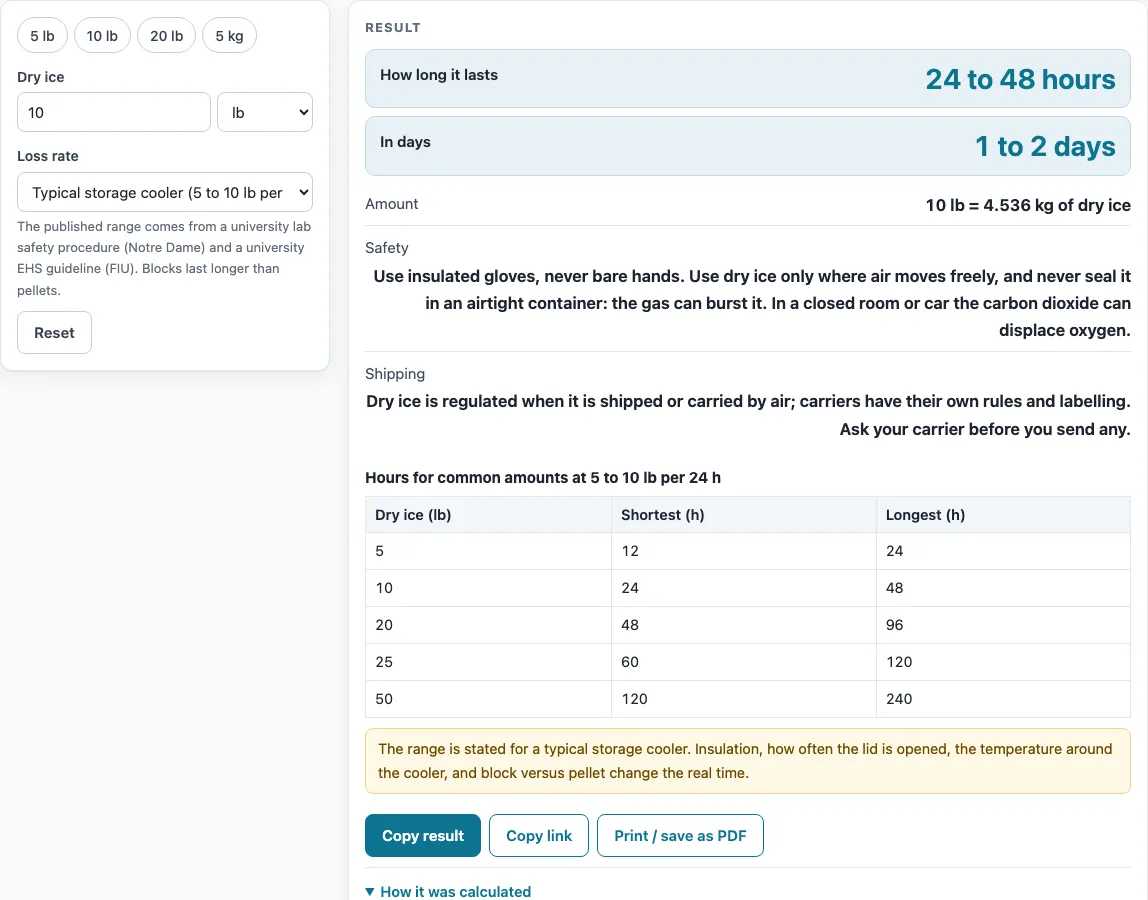
How to use the Dry Ice Calculator
- Enter the amount of dry ice in the “Dry ice” field, and choose whether it is in lb or kg.
- Under “Loss rate”, pick “Typical storage cooler (5 to 10 lb per 24 h)” or “My own rate range”.
- If you chose your own rates, type “Slowest loss (lb per 24 h)” and “Fastest loss (lb per 24 h)”. The slowest must not be more than the fastest. For example, 6 and 12 lb per 24 hours.
- Read “How long it lasts”. This is the shortest and longest time your dry ice may last, in hours.
- Read “In days”, which is the same time divided by 24.
- Check “Amount” to confirm the lb and kg conversion is what you expect.
- Read “Safety” and “Shipping” before you handle or move the dry ice.
- Check the table, which shows 5, 10, 20, 25 and 50 lb at the rate in use.
The presets “5 lb”, “10 lb”, “20 lb” and “5 kg” fill in the amount, so you can see a result without typing. If you enter more than 50 lb, a warning appears, because the loss range applies to a typical storage cooler. Read the warnings before you rely on the result, because insulation, lid opening and outside temperature all change the real time.
How long does dry ice last in a cooler?
Dry ice lasts until it has turned into gas. In a typical storage cooler, a Notre Dame lab procedure and a Florida International University (FIU) environmental health and safety page both give a loss of about 5 to 10 pounds every 24 hours. The Notre Dame procedure notes that blocks last longer than pellets.
Real results depend on your setup. Insulation, how often you open the lid, the outside temperature, and whether you use blocks or pellets all change the time. The calculator’s range is only a starting estimate. Other sources, such as vendor pages, give other cooler figures, and those were not used here.
How is the dry ice time calculated?
The time is the amount divided by the loss rate, multiplied by 24 hours. The shortest time uses the fastest loss rate of 10 lb per 24 hours, and the longest time uses the slowest rate of 5 lb per 24 hours:
- Shortest time = lb / 10 x 24 hours
- Longest time = lb / 5 x 24 hours
- Days = hours / 24
For 10 lb, the result is 24 to 48 hours, which is 1 to 2 days. For 5 lb, it is 12 to 24 hours. For 20 lb, it is 48 to 96 hours, which is 2 to 4 days. A 25 lb amount lasts 60 to 120 hours at the rate in use.
If you enter a different amount in kg, the tool converts it to pounds first. For example, 4 kg is 8.818 lb, which lasts 21.2 to 42.3 hours. If you type your own rate of 6 to 12 lb per 24 hours, 10 lb lasts 20 to 40 hours.
The FIU page says dry ice loses “10%, or 5 to 10 pounds every 24 hours, whichever is greater.” This wording is unclear about which figure applies, so the calculator does not use it. It uses only the 5 to 10 lb per 24 hours range, or the range you type yourself.
What should I know about safety and shipping?
The university safety sources give these points. Wear insulated gloves and never handle dry ice with bare hands. Use it only in open or well-ventilated areas. Never keep it in an airtight container, because the gas can burst it. In a closed room or car the carbon dioxide can displace oxygen. For shipping, FIU cites 49 CFR 171.8 and points out that dry ice is regulated, so carriers have rules of their own. Ask your carrier before you send any.
Sources (checked 15 October 2026): www3.nd.edu · ehs.fiu.edu
Worked examples
| Input | Result |
|---|---|
| 10 lb of dry ice | 24 to 48 hours |
| 5 lb of dry ice | 12 to 24 hours |
| 20 lb of dry ice | 48 to 96 hours |
| 8.818 lb of dry ice | 21.2 to 42.3 hours |
Calculated by the tool above; open it with the same values to see each step.
Frequently asked questions
Why does dry ice seem to disappear?
Dry ice is solid carbon dioxide. It changes directly from solid to gas in a process called sublimation, so it shrinks without melting into a liquid.
Does block dry ice last longer than pellets?
Yes. The Notre Dame procedure notes that blocks last longer than pellets in a typical storage cooler.
What happens if I enter my own loss rate?
The tool uses the slowest and fastest rates you type, in lb per 24 hours, instead of the typical storage cooler range. Your result will match the rates you entered.
Why does the tool warn me above 50 lb?
The loss range is stated for a typical storage cooler. Larger amounts may behave differently, so treat the result as a rough guide.
Can I store dry ice in a sealed container?
No. Never keep dry ice in an airtight container, because the gas can build up and burst it. Use it only in open or well-ventilated areas, and wear insulated gloves rather than handling it with bare hands. Carbon dioxide can also displace oxygen in closed rooms or cars.
Can I use this result to ship dry ice?
Not directly. Dry ice is regulated for shipping and air travel, and FIU cites 49 CFR 171.8. Carriers have their own rules, so ask your carrier before you ship.
Related tools
- Dry Ice Calculator: Use it when you want the dry ice time for a specific amount and rate.
- How Many Beers in a Keg?: Use it to estimate how many servings a keg holds.
- How Much Does a Keg Weigh?: Use it to check the weight of a full or empty keg.
- How Much Is a Keg of Beer?: Use it to build a cost worksheet from your own prices.
- Keg Sizes: Use it to compare common keg volumes.
- Kegs and Coolers: the hub page for all keg and dry ice tools.
- Food Temperatures and Holding: pages on keeping food cold.
- Cold Chain Monitoring: use it when cold goods travel between places.