How Much Does a Keg Weigh?
Pick the keg size. You get an estimated full weight (empty keg plus beer) beside the weights published for that keg, in pounds and kilograms.
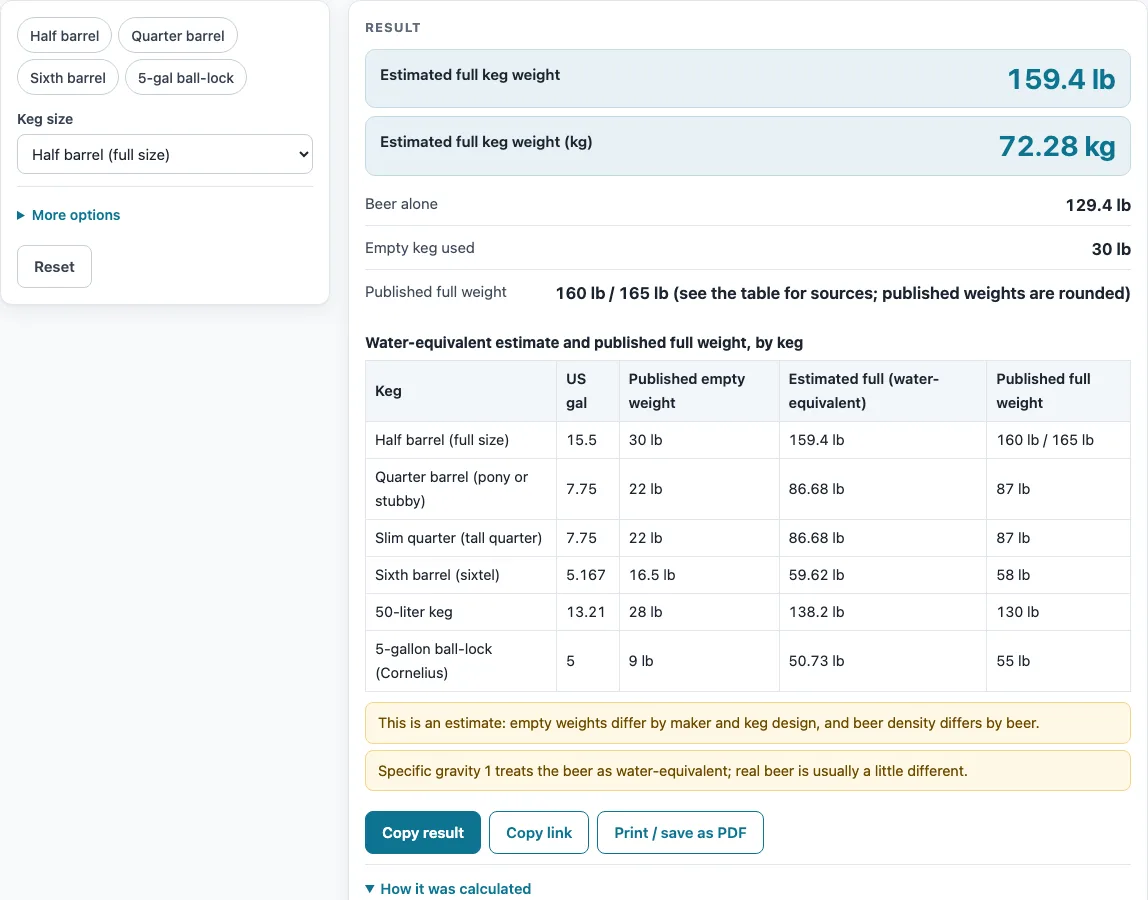
How to use the Keg Weight Calculator
Follow these steps to get an estimate for your keg.
- Choose a keg size from the “Keg size” menu: half barrel, quarter barrel, slim quarter, sixth barrel, 50-liter, or 5-gallon ball-lock.
- Leave “Specific gravity of the beer (1 = water)” at 1 if you want the beer treated as water. Type your own value if you know it. The value must be between 0.8 and 1.3.
- Optional: type an empty weight in pounds or kilograms in “Empty keg weight (optional).” This replaces the published empty weight for that keg, and the page shows a note saying so.
- Read “Estimated full keg weight” in lb, and “Estimated full keg weight (kg)” in kilograms.
- Check “Beer alone” to see the weight of the beer by itself.
- Check “Empty keg used” to confirm which empty weight was applied, and read “Published full weight” for the weight or weights listed in sources.
- Compare the table, which shows the water-equivalent estimate next to the published full weight for each keg.
- Read the warnings. They remind you that the result is an estimate, say when the water default is used, and say when your typed empty weight replaced the published one.
Presets are available for half barrel, quarter barrel, sixth barrel, and 5-gal ball-lock. Choose one to start from a common keg size, then adjust the specific gravity or empty weight if you need to.
How much does a keg weigh?
A keg weighs its empty weight plus the weight of the beer inside it. The published figures are not always the same, so the answer depends partly on the source. For a full half barrel, one keg retailer lists 160 lb and the Brewers Association lists 165 lb.
The published empty weights are 30 lb for a half barrel, 22 lb for a quarter barrel and slim quarter, 16.5 lb for a sixth barrel, 28 lb for a 50-liter keg, and 9 lb for a 5-gallon ball-lock. The published full weights are 58 lb for a sixth barrel, 87 lb for a quarter barrel and slim quarter, 130 lb for a 50-liter keg, and 55 lb for a ball-lock. The mini keg is not offered because no empty weight is published for it.
Here is how the calculator’s estimates compare with those figures at specific gravity 1, which treats the beer as water:
- Half barrel: 15.5 gallons × 8.3454 = 129.35 lb of beer. Add 30 lb empty for 159.35 lb (72.28 kg). This is close to the 160 lb retailer figure and a little under the 165 lb Brewers Association figure.
- Sixth barrel: 5.1667 × 8.3454 = 43.12 lb of beer. Add 16.5 lb empty for 59.62 lb, against 58 lb published.
- Quarter barrel at specific gravity 1.01: 7.75 × 8.3454 × 1.01 = 65.32 lb of beer. Add 22 lb empty for 87.32 lb, against 87 lb published.
How is the estimated weight calculated?
The beer weight is US gallons × 8.3454 lb per gallon × specific gravity. The estimated full weight is that beer weight plus the empty weight. The number 8.3454 is the weight of water in pounds per US gallon. It comes from one US gallon being 3.785411784 liters, water weighing 1 kg per liter, and 1 kg being 1 ÷ 0.45359237 lb.
Specific gravity compares the density of the beer with the density of water. A value of 1 means the beer is treated as water. Because the default is 1, the estimate is a water-equivalent figure. No public source for the typical specific gravity of finished beer was found, so the calculator does not assume a different value. If you know your beer’s specific gravity, type it in.
Two cases show where the estimate can differ from the published weight. For a 5-gallon ball-lock with a typed empty weight of 4 kg (8.818 lb), the beer is 41.73 lb and the total is 41.73 + 8.82 = 50.55 lb. For a 50-liter keg, the estimate is 138.2 lb, against 130 lb published. The difference is most likely due to the empty weight or the density used, so check the figures against your own keg if the result matters.
Sources (checked 15 October 2026): nist.gov · brewersassociation.org · kegworks.com
Worked examples
| Input | Result |
|---|---|
| Half barrel (full size), specific gravity 1, empty 30 lb | about 159.4 lb full |
| Sixth barrel (sixtel), specific gravity 1, empty 16.5 lb | about 59.62 lb full |
| Quarter barrel (pony or stubby), specific gravity 1.01, empty 22 lb | about 87.32 lb full |
| 5-gallon ball-lock (Cornelius), specific gravity 1, empty 8.818 lb | about 50.55 lb full |
Calculated by the tool above; open it with the same values to see each step.
Frequently asked questions
How much does a half barrel keg weigh full?
At specific gravity 1, the calculator estimates 159.35 lb (72.28 kg). Published full weights are 160 lb from one keg retailer and 165 lb from the Brewers Association.
What specific gravity should I enter?
The default is 1 because no public source for typical finished beer specific gravity was found. You can type your own value between 0.8 and 1.3. A value above 1 means the beer is denser than water and raises the estimate.
Why does my result differ from the published weight?
The empty weight or the density may be different from the published figures. For a 50-liter keg, the estimate is 138 lb against 130 lb published. Keg weights also vary by maker and keg design, so the result is an estimate, not a measured weight.
Can I enter my keg’s empty weight?
Yes. Type the empty weight in pounds or kilograms. It replaces the published empty weight, and the page shows a note saying so.
Is there a mini keg option?
No. The mini keg is not offered because no empty weight is published for it.
Does the calculator upload my numbers?
No. Everything runs in your browser, and nothing is uploaded. The page does not send your keg size, specific gravity or empty weight anywhere.
Related tools
- Dry Ice Calculator: Use it to work out how much dry ice you need for a cooling plan.
- How Long Does Dry Ice Last?: Read this to understand how long dry ice keeps before it is used up.
- How Many Beers in a Keg?: Use it when you want to know how many servings a keg holds.
- How Much Is a Keg of Beer?: Use it when you want to plan the cost of a keg using your own prices.
- Keg Sizes: Read it to compare the keg sizes before you choose one.
- Kegs and Coolers: the hub page for all keg and dry ice tools.
- Restaurant Costs: other cost tools for a bar or restaurant.
- Food Temperatures and Holding: pages on keeping food cold.