How Much Is a Keg of Beer?
Type the keg price and deposit you were quoted. You get the cost per serving, per pint and per ounce, how many to sell to break even, and kegs and cost for a party.
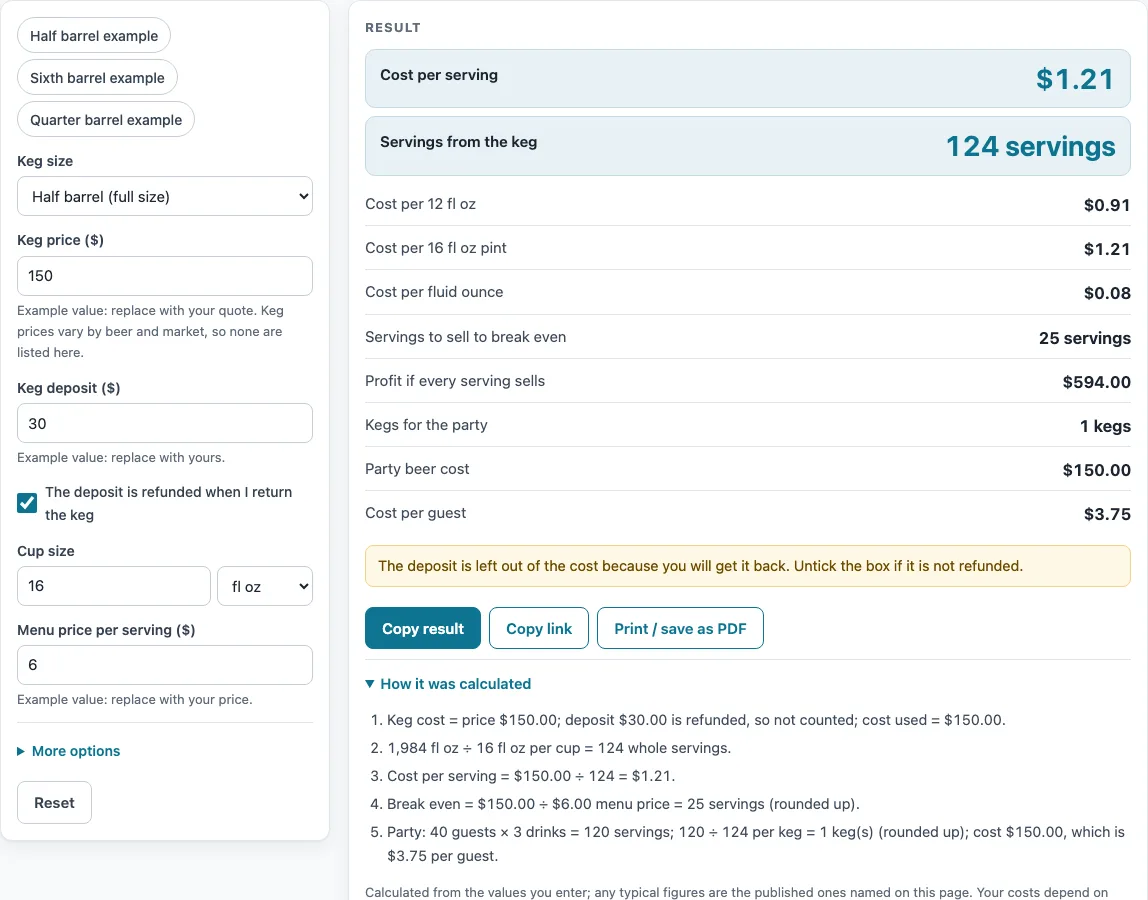
How to use the keg price worksheet
- Choose a “Keg size”, or start with the “Half barrel example”, “Sixth barrel example” or “Quarter barrel example” preset. The presets use example prices, not market prices.
- Type your keg price in “Keg price ($)” in place of the example $150.
- Type the deposit in “Keg deposit ($)”, then tick or untick “The deposit is refunded when I return the keg”. A refunded deposit is left out of the cost.
- Set the “Cup size” in fl oz, mL or L. It starts at 16 fl oz.
- Type your “Menu price per serving ($)”.
- Read “Servings from the keg”, “Cost per serving”, “Cost per 12 fl oz”, “Cost per 16 fl oz pint” and “Cost per fluid ounce”.
- Check “Servings to sell to break even” and “Profit if every serving sells”. A warning appears if the menu price is too low to cover the keg even when every serving sells.
- For a party, open “More options” and enter “Party guests”, “Drinks per guest” and “Foam and waste (%)”. The waste figure starts at 0, and you enter your own.
- Read “Kegs for the party”, “Party beer cost” and “Cost per guest”.
If a field shows an error, check the number. Price, menu price, guests and drinks must be greater than zero, and the deposit cannot be negative. A cup size that does not fill from the keg is also rejected, so try a smaller cup.
Replace the preset values with your own. For a per-serving check, leave “More options” closed.
How much is a keg of beer per serving?
Cost per serving is the total cost of the keg divided by the number of servings it gives. The total cost is the keg price, plus the deposit only when the deposit is not refunded.
Servings come from the keg volume, using this formula:
servings = floor(keg fl oz × (1 − waste/100) ÷ cup fl oz)
The floor function rounds down, so a partial cup does not count. A half barrel is 15.5 US gallons, or 1,984 fl oz, the same volume listed on the keg sizes page. The waste percentage removes foam and spillage from the usable volume. With a 16 fl oz cup and no waste, a half barrel gives 1,984 ÷ 16 = 124 servings.
At the example price of $150, cost per serving is $150 ÷ 124, which is $1.21 per 16 fl oz pint. For a 12 fl oz serving, the tool divides cost by floor(fl oz ÷ 12), giving $0.91 in this example. Dividing cost by usable fluid ounces gives $0.08 per fl oz.
Break-even servings is cost divided by the menu price, rounded up: ceiling(cost ÷ menu price). At $6 a serving, $150 needs 25 servings to break even. If all 124 servings sell, profit is 124 × $6 − $150, which is $594.00.
If the example $30 deposit is not refunded, the cost becomes $180. Cost per serving then rises to $1.45, and break-even becomes 30 servings. All of these dollar amounts are example values from the form, not market prices. Your own keg price, deposit and menu price replace them.
How do you work out the cost of a keg for a party?
Start with the servings needed: guests × drinks each. Divide that by the servings per keg and round up to a whole number of kegs, so kegs = ceiling(servings needed ÷ servings per keg). Party cost is kegs × cost, and cost per guest is party cost ÷ guests.
With the example values, 40 guests × 3 drinks = 120 servings. That fits in one half barrel of 124 servings, so the party cost is $150.00, or $3.75 per guest. For 100 guests × 4 drinks, you need 400 servings. 400 ÷ 124 is about 3.2, so the party needs 4 kegs, which costs $600.00.
Because kegs are counted whole, a party that goes just over one keg’s servings pays for the full extra keg. Enter your own guest count and drinks per guest to see how many kegs that creates. The tool does not know what drinks your guests will actually pour, so the guests and drinks figures are your own estimate.
Sources (checked 15 October 2026): nist.gov · law.cornell.edu
Worked examples
| Input | Result |
|---|---|
| Half barrel (full size), cost $150.00 | $1.21 per serving, 124 servings |
| Sixth barrel (sixtel), cost $90.00 | $2.20 per serving, 41 servings |
| Quarter barrel (pony or stubby), cost $180.00 | $2.20 per serving, 82 servings |
| Half barrel (full size), cost $150.00 | $1.35 per serving, 111 servings |
Calculated by the tool above; open it with the same values to see each step.
Frequently asked questions
Why doesn’t this page show a keg price?
Keg prices vary by beer and market, so this page does not publish one. Type the price you have been quoted or have paid, and every result updates from your number.
Should I include the deposit in the cost?
Include it only when it is not refunded. If the deposit is refunded, the tool leaves it out of the cost. The non-refunded case is useful for checking the worst-case cost per serving.
What does the foam/waste percent do?
It reduces the usable volume of the keg before servings are counted. Enter the share of the keg you expect to lose to foam or spills. The default is 0, which counts the full keg volume.
What happens if a cup size does not fill from the keg?
The tool rejects that cup size with an error. Choose a smaller cup size, and the servings and cost figures will update.
What does the warning about menu price mean?
It appears when the menu price is too low to cover the keg, even if every serving sells. Raise the menu price or check the keg price you entered.
Does the tool send my numbers anywhere?
No. The tool runs in your browser, and nothing you type is uploaded. It is free.
Related tools
- Keg Sizes: use it to check the volume of each keg before you choose a cup size or waste percentage.
- How Many Beers in a Keg?: use it when you want a beer count rather than a cost.
- How Much Does a Keg Weigh?: use it when you need to plan how to move or lift a keg.
- Kegs and Coolers: the hub page for all keg and dry ice tools.
- Restaurant Costs: other cost tools for a bar or restaurant.
- Pour Cost Calculator: use it to turn your own drink costs into a pour cost.
- Catering Calculator: use it when the party is an event you cater.