Pour Cost Calculator
Enter the bottle size, what you paid, your pour size and a menu price; you get pours per bottle, cost per pour, the pour cost percentage and the price that reaches a target.
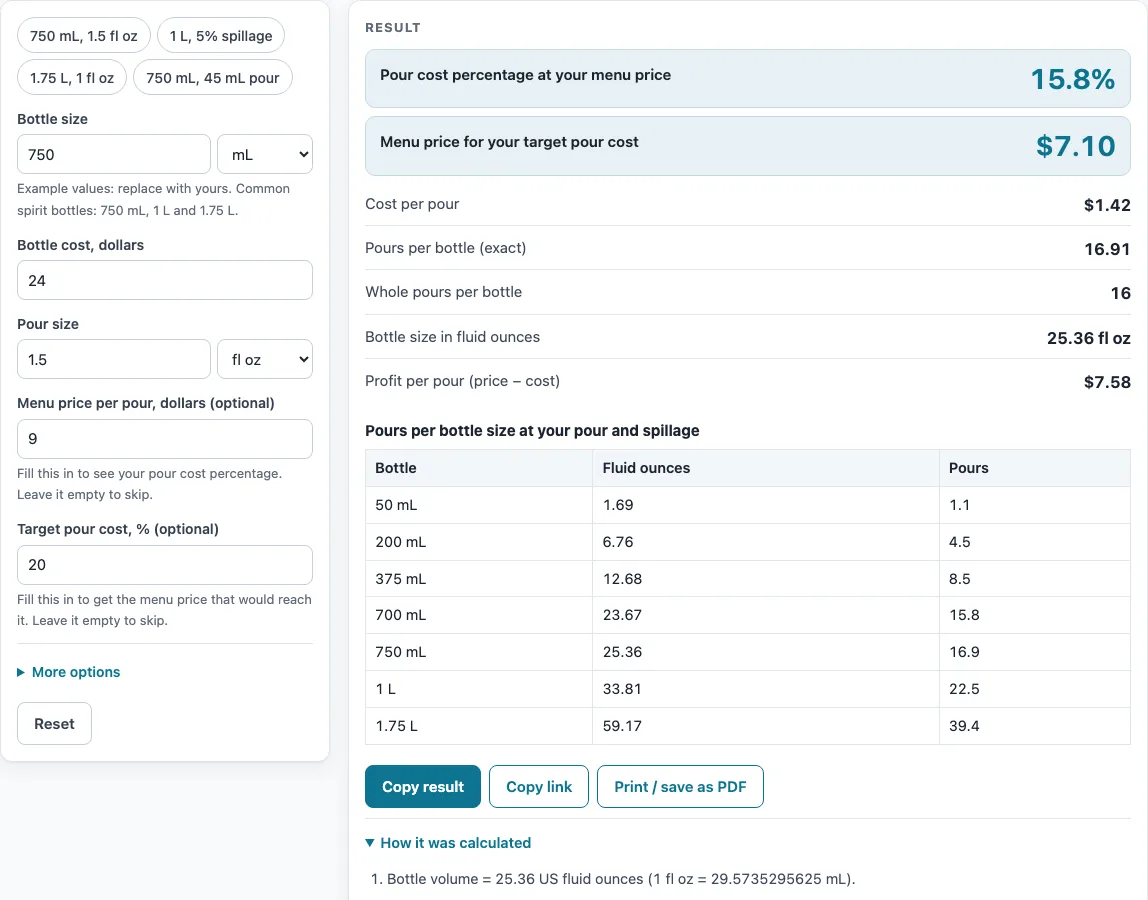
How to use the Pour Cost Calculator
- Choose the bottle size and its unit: mL, L or fl oz. For example, enter 750 mL.
- Type the bottle cost in dollars, such as 24.
- Type your pour size and choose fl oz or mL, such as 1.5 fl oz.
- Optional: type the menu price per pour, such as 9.
- Optional: type a target pour cost in %, such as 20.
- Optional: open “More options” and enter spillage and waste as a percent of the bottle. The default is 0.
- Read the results: pours per bottle (exact and whole), “Cost per pour”, “Pour cost percentage at your menu price”, “Profit per pour (price − cost)” and “Menu price for your target pour cost”.
- Check the messages. An error appears when your pour is larger than the usable part of the bottle. A warning appears when the cost per pour is above the menu price.
The page has four presets you can load to see how the tool works: 750 mL at 1.5 fl oz, 1 L with 5% spillage, 1.75 L at 1 fl oz, and 750 mL at a 45 mL pour. If you are not sure of a bottle’s volume, the table on the page lists 50 mL, 200 mL, 375 mL, 700 mL, 750 mL, 1 L and 1.75 L bottles, with their fluid ounces and the number of pours at your pour size.
What does a pour cost calculator measure?
A pour cost calculator measures how much of a bottle’s price goes into each serving. It turns one purchase into a cost per pour, then compares that cost with the price you charge. The result is the pour cost percentage, which is the share of the menu price that the drink’s spirit costs you.
How do you turn a bottle into a number of pours?
Start with the bottle volume, converted to fluid ounces. The tool uses 1 US fluid ounce = 29.5735295625 mL, the figure the National Institute of Standards and Technology lists as 29.57353 mL per fluid ounce (SP 811, Appendix B.8). So a 750 mL bottle holds 25.36 fl oz, a 1 L bottle holds 33.81 fl oz and a 1.75 L bottle holds 59.17 fl oz. The TTB table shows these rounded to 25.4, 33.8 and 59.2.
Divide the usable volume by your pour size. For example, 25.36 fl oz divided by a 1.5 fl oz pour gives 16.91 pours, which is 16 whole pours. The tool shows both the exact and the whole number.
How does spillage change the number of pours?
Spillage and waste reduce the usable volume. The tool calculates usable volume as bottle volume multiplied by (1 minus the spillage percentage). A 1 L bottle with 5% spillage has 32.12 usable fl oz, not 33.81, so it gives fewer pours at the same pour size. The default spillage is 0, so the tool assumes the full bottle is poured unless you change the setting.
How is the pour cost percentage calculated?
First find the cost per pour. Divide the bottle cost by the exact number of pours, not the whole number. Then divide the cost per pour by the menu price per pour and multiply by 100. In the first example, a $24 bottle giving 16.91 pours costs $1.42 per pour. At a $9 menu price, the pour cost is 15.8%.
The profit per pour is the menu price minus the cost per pour. At $9 and $1.42, the profit per pour is $7.58 before any other costs.
How do you find a menu price from a target pour cost?
Divide the cost per pour by the target percentage, written as a decimal. The tool rounds the result up to the next cent, so the price always meets or beats your target. With a $1.42 cost per pour and a 20% target, the price is $7.10. In the second example, a $30 litre bottle at 5% spillage gives $1.40 per pour, and an 18% target gives a price of $7.79.
Use these results as a starting point. The price you choose may depend on other costs that this tool does not include, such as mixers, garnish and labour.
Sources (checked 15 October 2026): nist.gov · ttb.gov
Worked examples
| Input | Result |
|---|---|
| 750 mL bottle at $24.00, 1.5 fl oz pour | 16.91 pours, $1.42 each |
| 1 L bottle at $30.00, 1.5 fl oz pour | 21.42 pours, $1.40 each |
| 1.75 L bottle at $36.00, 1 fl oz pour | 59.17 pours, $0.61 each |
| 750 mL bottle at $20.00, 45 mL pour | 16.67 pours, $1.20 each |
Calculated by the tool above; open it with the same values to see each step.
Frequently asked questions
Is the pour cost calculator free to use?
Yes. The tool is free, needs no sign-up and runs in your browser.
Does the tool upload or store the numbers I enter?
Everything runs in your browser, and nothing you type is uploaded.
Does the tool assume a typical pour size or spillage rate?
No. You type in the pour size, the target percentage and the spillage. Spillage is 0 unless you change it under “More options”.
What is the difference between the exact and whole number of pours?
The exact number, such as 16.91, is used to calculate the cost per pour. The whole number, such as 16, is how many full pours the bottle will give at that size.
Why does the tool show an error or a warning?
An error appears when your pour is larger than the usable part of the bottle, so the bottle cannot give a single full pour. A warning appears when the cost per pour is above the menu price, which means the drink costs more to pour than it sells for.
Can I enter my volumes and prices in mL or fl oz?
Yes. The bottle size can be in mL, L or fl oz, and the pour size can be in fl oz or mL. The tool converts between them for you.
Related tools
- Catering Calculator: use it to plan quantities and costs for an event menu.
- How Much Does a Food Truck Cost? Startup Cost Worksheet: use it to estimate the startup costs of a mobile food business.
- Restaurant Budget Template: use it to set up a monthly budget for your restaurant’s expenses.
- Restaurant Labor Cost Calculator: use it to work out what your staffing costs as part of your overall spending.
- How Much Does It Cost to Open a Restaurant? Cost Worksheet: use it to list the costs you would face when opening a restaurant.
- Restaurant Tip Calculator: use it to work out tip amounts for a bill.
- Tip Pool Calculator: use it to split tips among staff.
- Restaurant Costs: the hub page for all the cost worksheets and calculators on this site.