Restaurant Cleaning Checklist
Pick the task groups you need, add your own lines and print the sheet or download it as CSV; the Food Code sanitizer limits are printed under it.
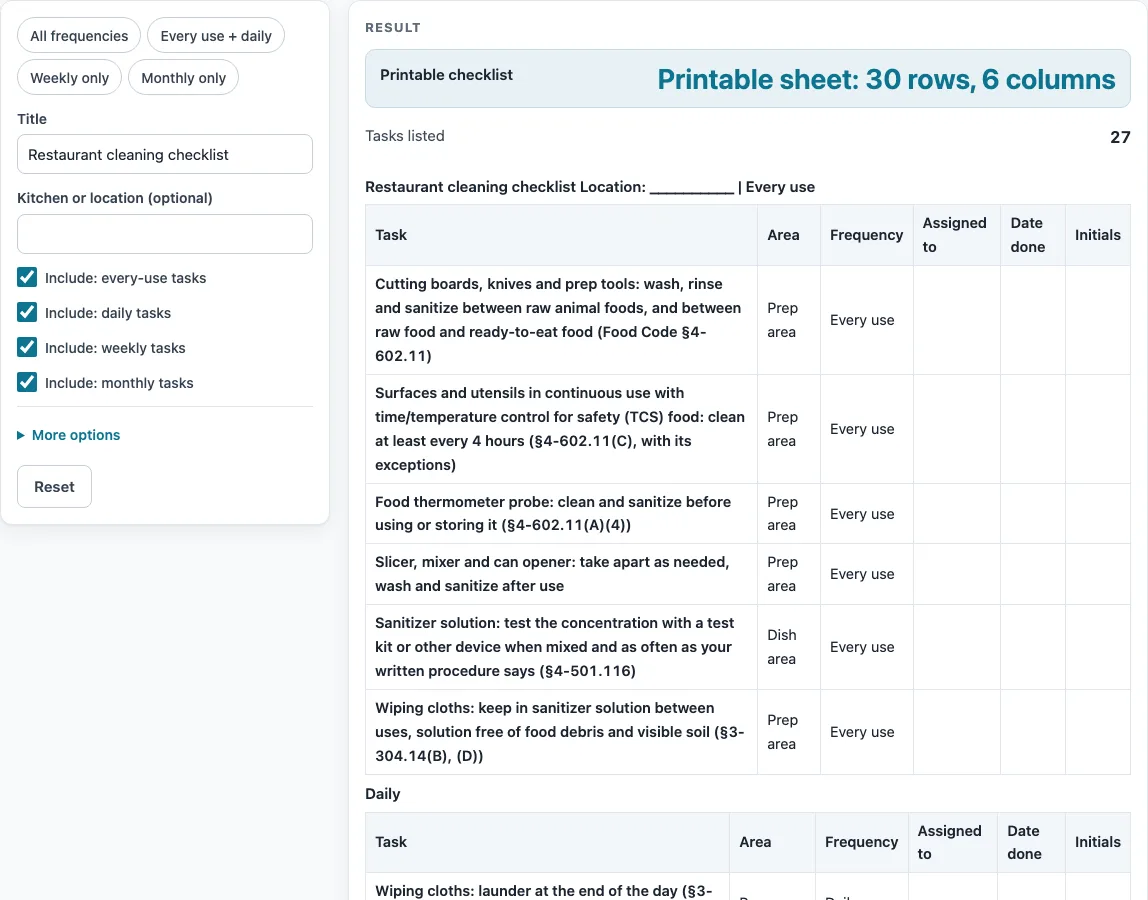
How to use the Restaurant Cleaning Checklist
- Look at the four groups: every use (6 tasks), daily (10), weekly (6) and monthly (5), 27 tasks in all.
- Tick the groups you need. At least one must stay ticked, or the page shows the error “Tick at least one frequency.”
- Optionally type a title and a kitchen or location name for the header of the sheet.
- Set the number of blank lines for your own tasks. The default is 3, and you can use 0 to 20. Anything above 20 is capped at 20 with a warning.
- Use the temperature unit switch to show °F or °C. The Celsius figures are the Food Code’s own printed pairs, so the page does not convert them.
- Keep or switch off the “Assigned-to column”. Each row then shows Task, Area, Frequency, Assigned to, Date done and Initials.
- Decide whether to keep the sanitizer reference table printed under the checklist. It is on by default.
- Press “Print” to print the tables, or “CSV” to download all tables. Fill in the Date done and Initials by hand as each task is finished.
The “Print” button prints the same tables you see on screen. With the defaults, the sheet has 30 rows in 6 columns: 27 tasks plus 3 blank lines. If you only tick the weekly group, you get the 6 weekly tasks. Nothing you type is uploaded.
What is the Food Code, and why does it matter for a cleaning checklist?
The FDA publishes the Food Code as a model code, and local health departments adopt an edition of it. Your health department’s adopted code governs your kitchen and may be stricter than the model. This page cites Food Code 2022, the full text we could read, and tells you to follow your adopted edition.
Which cleaning tasks come from the Food Code, and which are suggestions?
Tasks that cite a Food Code section name it in the task text. These include 4-602.11 for food-contact surfaces, 4-602.11(A)(4) for the thermometer probe, 4-501.116 for the test kit, 3-304.14 for wiping cloths, 6-501.12 for floors, 5-205.11 for handwashing sink access, 4-602.13 for non-food-contact surfaces and 6-501.111 for pests. The other tasks use suggested frequencies. The Food Code 2022 gives no fixed daily, weekly or monthly schedule for them, and the page says so.
What do the sanitizer limits in the reference table mean?
The table comes from section 4-501.114 and shows the concentration, water temperature and pH limits for each sanitizer. For chlorine, 25 to 49 mg/L needs water of at least 49 °C (120 °F), 50 to 99 mg/L needs at least 38 °C (100 °F) at pH 10 or less or 24 °C (75 °F) at pH 8 or less, and 100 mg/L needs at least 13 °C (55 °F). For iodine, 12.5 to 25 mg/L needs pH 5.0 or less, or the pH the maker states, and at least 20 °C (68 °F). For quaternary ammonium, the limit is at least 24 °C (75 °F), with the concentration on the EPA-registered label.
Contact times come from section 4-703.11(C): at least 10 seconds for chlorine, 7 seconds for 50 mg/L chlorine at the pH and temperature above, and 30 seconds for other chemical sanitizers. Always check the product label as well. The table ends with the line that section 4-501.116 requires the concentration to be determined with a test kit or other device.
How often should food-contact surfaces be cleaned?
Section 4-602.11 requires cleaning at set events and at least every 4 hours for TCS food in continuous use. Clean and sanitize the food thermometer probe before using or storing it, as in 4-602.11(A)(4). Wiping cloths held in sanitizer must be laundered daily under 3-304.14. Floors must be cleaned when the least food is exposed, such as after closing, under 6-501.12. Keep handwashing sinks accessible under 5-205.11, and clean non-food-contact surfaces under 4-602.13.
Why does the page show temperatures in both °F and °C?
The switch changes the display between °F and °C. The Celsius values are the Food Code’s own printed pairs, not conversions made by the page. Read the pair as printed, and use the temperature your product label and health department expect.
What does this checklist not tell you?
The checklist does not give a verdict on your kitchen. It gives you a list of tasks, limits from the Food Code 2022, and space to record your work. Your local health department’s adopted code decides what applies to your kitchen.
Sources (checked 15 October 2026): fda.gov · fda.gov
Worked examples
| Input | Result |
|---|---|
| 27 tasks | 30 rows, 6 columns |
| 16 tasks | 19 rows, 5 columns |
| 6 tasks | 6 rows, 6 columns |
| 6 tasks | 11 rows, 6 columns |
Calculated by the tool above; open it with the same values to see each step.
Frequently asked questions
Is this restaurant cleaning checklist the same as a kitchen cleaning schedule?
Not exactly. The checklist lists tasks in four groups and records who did them and when. A kitchen cleaning schedule is the plan for when each task happens, so you can use the checklist to build that plan.
How many tasks are on the checklist?
There are 27 tasks: 6 for every use, 10 daily, 6 weekly and 5 monthly. You can add 0 to 20 blank lines for your own tasks.
Which code should I follow for my kitchen?
Follow the code your local health department has adopted. The page cites Food Code 2022 and notes that the adopted edition governs, and your health department may be stricter than the model.
Does the checklist give a verdict on my kitchen?
No. The page gives no verdict on a kitchen. It provides the tasks and reference limits so you can check your own work against your adopted code.
Is my information saved or uploaded?
Everything runs in your browser, and nothing is uploaded. There is no sign-up, and the tool is free.
What does the Print button produce?
The “Print” button prints the same tables you see on the page, including the sanitizer reference table if it is turned on. The “CSV” button downloads all tables.
Related tools
Cleaning and Sanitizing Log: Use it to record cleaning and sanitizing as it happens.
Corrective Action Form: Use it to document what you did when a problem is found.
Food Safety Checklist: Use it to check food safety tasks beyond cleaning.
Food Waste Log: Use it to track the food your kitchen throws away.
Receiving Log: Use it to record deliveries when they arrive.
Restaurant Inventory Template: Use it to keep track of stock on hand.
Restaurant Opening Checklist: Use it to prepare the kitchen before service begins.
Kitchen Checklists and Logs: see all the checklists and logs on this site in one place.