Restaurant Labor Cost Calculator
List each position with its hours and hourly wage, type your payroll burden percentage and the period's sales; you get labor cost, labor percentage and sales per labor hour.
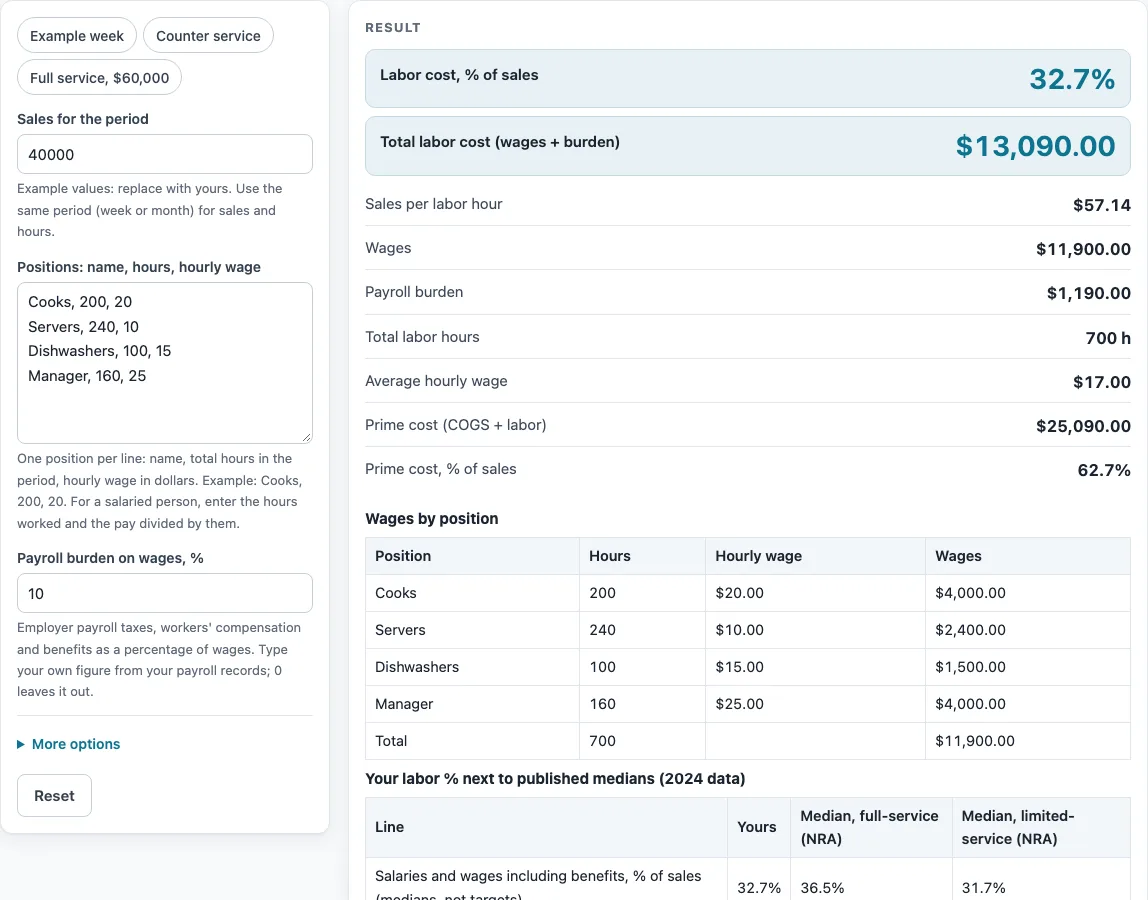
How to use the Restaurant Labor Cost Calculator
- Enter your sales for the period in dollars. The number must be above zero.
- In the positions box, type one position per line in this form: name, hours, hourly wage. For example: Cooks, 200, 20.
- You can separate the cells with commas, semicolons or tabs. Enter up to 60 lines.
- Type your payroll burden as a percentage. Leave it empty if you want to use 0%. No burden is assumed for you, so use your own figure.
- Optionally, enter your food and drink cost (COGS) in dollars. Leave it empty if you only want labor figures.
- Read the results: labor cost, labor % of sales, sales per labor hour and average hourly wage. If labor cost is more than the sales you entered, a warning appears. If total hours are zero, an error appears.
- Check the table, which lists hours, wage and wages for each position with a total row.
If a line has the wrong number of cells or a negative number, the error names that line, so you can fix it and recalculate. The presets “Example week”, “Counter service” and “Full service, $60,000” load sample figures you can overwrite. The CSV button downloads the position table so you can save it or open it in a spreadsheet.
How is restaurant labor cost calculated?
Labor cost is your wages multiplied by one plus your payroll burden. Wages are the sum of each position’s hours times its hourly wage, and total hours are the sum of all the hours.
What is restaurant labor cost percentage?
Restaurant labor cost percentage is labor cost divided by sales for the same period. Using the example values, wages are $11,900.00 and labor cost is $13,090.00 after a 10% burden, which is 32.7% of sales of $40,000. The 10% is a placeholder, so replace it with your own burden figure from your payroll records before you rely on the result. No burden is assumed for you.
How do sales per labor hour and average hourly wage work?
Sales per labor hour is sales divided by total hours, and average hourly wage is wages divided by total hours. In the example, 700 hours give $57.14 of sales per labor hour and an average wage of $17.00.
How do the numbers change with a different set of inputs?
Take a second example: sales of $25,000, Cook 120 hours at $18 and Counter 150 hours at $14, and a burden of 8%. Wages are $4,260.00, labor cost is $4,600.80, which is 18.4% of sales, and sales per labor hour are $92.59. Every value here is one you type, so a different period, staff list or burden changes all of them. For a salaried person, enter the hours worked and the pay divided by those hours.
What is prime cost and when is it shown?
Prime cost is food and drink cost (COGS) plus labor cost, and prime cost % is prime cost divided by sales. The tool shows it only when you enter COGS. In the example, $12,000 plus $13,090.00 gives $25,090.00, which is 62.7% of sales. This definition follows Johnson & Wales University.
How do the National Restaurant Association medians compare?
The second table places your labor % beside medians for 2024 from the National Restaurant Association’s 2025 Restaurant Operations Data Abstract, which covers more than 900 operators. Salaries and wages including benefits were 36.5% of sales for full-service restaurants and 31.7% for limited-service restaurants. These are medians, not targets, so use them only as a reference point.
Can I compare more than one period?
Yes. Run the calculator once for each period, using the same sales and hours period each time, and read the labor percentage and sales per labor hour side by side. The presets “Example week”, “Counter service” and “Full service, $60,000” show how the results change when the sales, hours and wages change. All of their figures are placeholders you replace with your own.
Sources (checked 15 October 2026): online.jwu.edu · restaurant.org
Worked examples
| Input | Result |
|---|---|
| Sales $40,000.00, 4 positions, 700 hours | Labor 32.7% of sales ($13,090.00) |
| Sales $25,000.00, 2 positions, 270 hours | Labor 18.4% of sales ($4,600.80) |
| Sales $60,000.00, 3 positions, 830 hours | Labor 24.2% of sales ($14,504.00) |
Calculated by the tool above; open it with the same values to see each step.
Frequently asked questions
Is this restaurant labor cost calculator free to use?
Yes. It is free, runs in your browser and needs no sign-up. Nothing you enter is uploaded.
What is a good restaurant labor cost percentage?
The page does not say whether a labor percentage is good or bad. The National Restaurant Association medians in the second table (2024 data) are a reference point, not a target.
What if I don’t know my payroll burden?
No burden percentage is assumed for you. Type your own figure, or leave the field empty to use 0%. The example uses 10% only as a placeholder to replace.
Why does the tool show a warning?
A warning appears when labor cost is more than the sales you entered. Check the sales figure and your hours and wages first. An error appears when total hours are zero.
Which hours and sales should I use?
Use the same period for both, such as one week or one month. The sales box is the sales for that period, and the positions box holds the total hours each position worked in it.
Can I use this for tips or catering costs?
This page covers labor cost only. Related tools for other cost questions are listed below.
Related tools
- Pour Cost Calculator: use it to work out the cost of drinks you pour.
- Restaurant Budget Template: use it to plan your monthly costs around labor and other expenses.
- Restaurant Tip Calculator: use it to split tips for a shift or period.
- Tip Pool Calculator: use it when staff share a tip pool.
- Catering Calculator: use it to estimate the cost of catered events.
- How Much Does It Cost to Open a Restaurant? Cost Worksheet: use it to estimate startup costs for a restaurant.
- How Much Does a Food Truck Cost? Startup Cost Worksheet: use it to estimate startup costs for a food truck.
- Restaurant Costs: the hub page for all the cost worksheets and calculators on this site.