TCS Food List
Search what the Food Code definition of time/temperature control for safety food names, or enter a water activity and pH to read the definition's Table A or Table B.
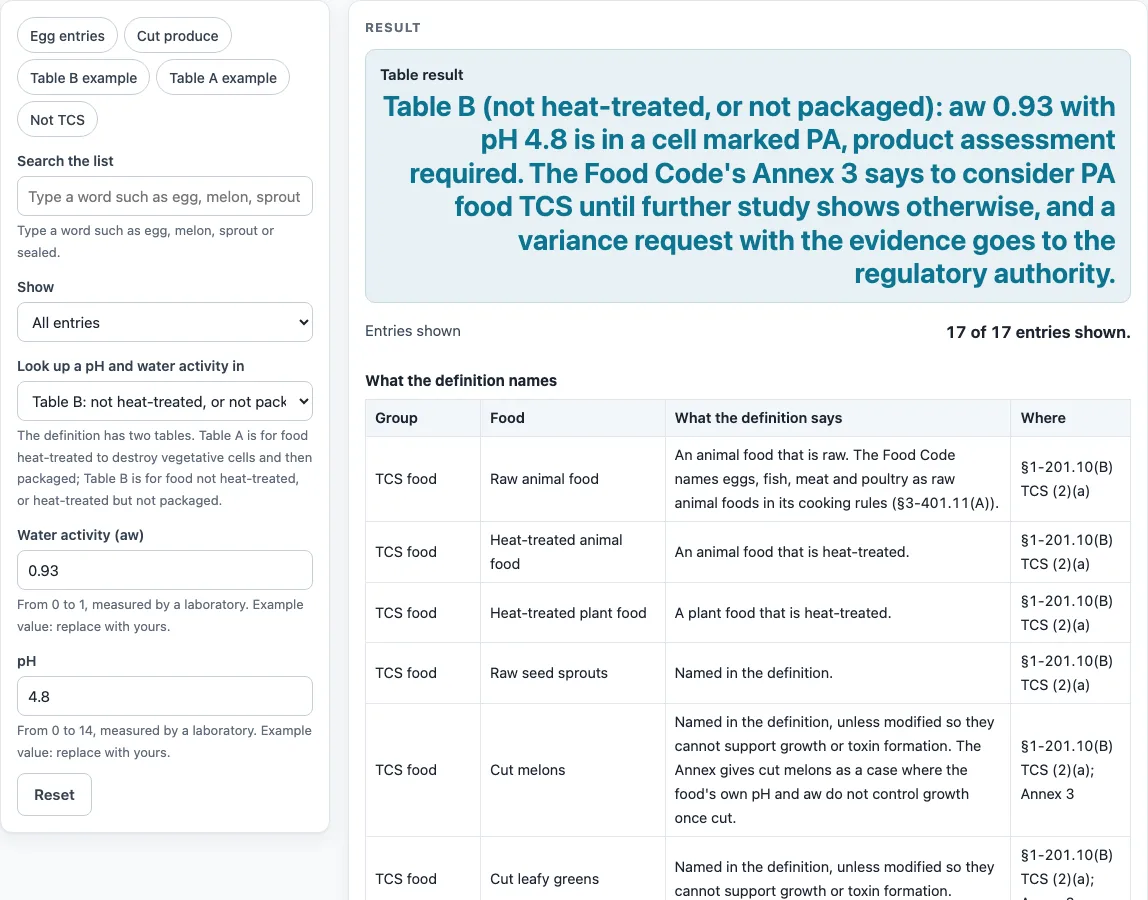
How to use the TCS food list
- Type a word into the search box, such as egg, melon, sprout, or sealed, to find matching entries.
- Filter by group: named as TCS, product assessment required (PA), or named as not TCS.
- Check the line that says how many of the 17 entries are shown, so you know whether your filter has hidden anything.
- Read each entry’s group. Four named-as-TCS entries (garlic-in-oil mixtures, cut tomatoes or mixtures of cut tomatoes, cut leafy greens, and cut melons) are TCS unless modified so they cannot support growth or toxin formation.
- To check a product’s numbers, enter its water activity (aw), a number above 0 and up to 1, and its pH, a number from 0 to 14.
- Decide which table fits the food first. Table A applies to food heat-treated to destroy vegetative cells and then packaged. Table B applies to food not heat-treated, or heat-treated but not packaged.
- Read the result. A warning appears for unusual values and when a search matches nothing. An aw of 0 or below, an aw above 1, a pH outside 0 to 14, or a value that is not a number produces an error, so correct the entry and check again.
- Use the result as a reading of the tables only. The lookup does not replace the whole definition, and the regulator applies that definition.
What does time/temperature control for safety (TCS) mean?
A TCS food is one that needs time and temperature control to limit the growth of pathogenic microorganisms or the formation of toxins. The FDA Food Code 2022 defines it in section 1-201.10(B), and the TCS food list is built from that definition.
How do water activity and pH decide whether a food is TCS?
The lookup reads two tables using a water activity (aw) and a pH. Table A is for food heat-treated to destroy vegetative cells and then packaged. Table B is for food not heat-treated, or heat-treated but not packaged. Each table has rows for aw and columns for pH, and the boundaries follow the table headings. For example, aw 0.92 belongs to the lower row, and pH 4.6 belongs to the lower column.
In Table A, aw 0.92 or below is non-TCS at every pH. Above 0.92 and up to 0.95, the food is PA only above pH 5.6. Above 0.95, it is non-TCS at pH 4.6 or below and PA above that. In Table B, aw below 0.88 is non-TCS at every pH, and aw 0.88 to 0.90 is PA only above pH 5.0.
A worked example shows how a cell is read. Table B, aw 0.93, pH 4.8 falls in a PA cell. Table A, aw 0.85, pH 6.5 is non-TCS, and so is Table B, aw 0.85, pH 6.5, because aw is below 0.88.
What does a product assessment (PA) food mean?
A PA food is one where the answer depends on a product assessment. Annex 3 says to consider a PA food TCS until further study shows otherwise. If you want to treat it differently, the Code requires a variance request to the regulator, with the evidence.
Which foods does the FDA Food Code name as TCS?
The definition names several foods directly as TCS. These include raw or heat-treated animal food, heat-treated plant food, raw seed sprouts, cut melons, cut leafy greens, and cut tomatoes or mixtures of cut tomatoes. Garlic-in-oil mixtures are also named, unless modified so they cannot support growth or toxin formation.
The definition also names foods that are not TCS. Examples include an air-cooled hard-boiled egg with the shell intact, and a shell egg pasteurized to destroy all viable salmonellae. Food in an unopened hermetically sealed container that is commercially sterile and stored without refrigeration is also named as not TCS.
Sources (checked 15 October 2026): fda.gov
Worked examples
| Input | Result |
|---|---|
| All entries; lookup: Table B: not heat-treated, or not packaged | Table B (not heat-treated, or not packaged): aw 0.93 with pH 4.8 is in a cell marked PA, product assessment required. The Food Code's Annex 3 says to consider PA food TCS until further study shows otherwise, and a variance request with the evidence goes to the regulatory authority. |
| All entries; lookup: Table A: heat-treated and packaged | Table A (heat-treated and packaged): aw 0.97 with pH 5.2 is in a cell marked PA, product assessment required. The Food Code's Annex 3 says to consider PA food TCS until further study shows otherwise, and a variance request with the evidence goes to the regulatory authority. |
| Named as not TCS food; lookup: Do not look anything up | 7 of 17 entries shown. |
| All entries; lookup: Do not look anything up | 1 of 17 entries shown. |
| All entries; lookup: Table B: not heat-treated, or not packaged | Table B (not heat-treated, or not packaged): aw 0.85 with pH 6.5 is in a cell marked non-TCS food. The definition excludes food designated non-TCS in the table (§1-201.10(B) TCS (3)(c)). Your regulator applies the whole definition. |
Calculated by the tool above; open it with the same values to see each step.
Frequently asked questions
Does being on this list rate a food?
No. The page only reports what the Food Code definition names. The aw and pH values should come from a laboratory, as the Annex describes. Your local health department adopts its own code edition and may apply stricter rules.
What does the “product assessment required (PA)” group mean?
PA foods need a product assessment before they can be classed. Annex 3 says to treat them as TCS until further study shows otherwise. Changing that treatment requires a variance request to the regulator.
Is a UHT creamer a TCS food?
Annex 3 gives UHT creamers as an example of food processed and packaged so it no longer requires TCS. The page marks this as a question the Annex raises, not a list of exempt foods. Check your local rules before relying on it.
Why does the lookup show a warning?
A warning appears for unusual values and when a search matches nothing. Check the aw and pH you entered, and try a different word in the search.
Does the tool send my numbers anywhere?
No. Everything runs in the browser, and nothing is uploaded. There is no sign-up.
Where do the aw and pH numbers come from?
Use values from a laboratory, as Annex 3 describes. Estimates or values from other sources may not match the tables’ boundaries.
Related tools
Food Temperatures, Holding and Cooling: use it to see every food temperature page on this site in one place.
Food Danger Zone Time Calculator: use it to work through time spent in the temperature range that the danger zone describes.
Hot Holding Temperature Checker: use it when you need to check hot food held for service.
How Long Can Food Sit Out?: use it to think through how long a food has been out of temperature control.
Two-Stage Cooling Method Checker: use it when you are cooling cooked food in two stages.
Food Temperature Log: use it to record food temperatures over time.
Cold Chain Monitoring: Logger CSV to Printable Report: use it to turn temperature logger data into a report.
Walk-In Cooler and Freezer Temperature Log: use it to record cooler and freezer temperatures.
Vaccine Temperature Log: use it to record temperatures for vaccine storage.