What Is a HACCP Plan?
A HACCP plan is the written document that sets out how a food business controls its food safety hazards. Tick what you have done so far and see the next step among the five preliminary tasks and seven principles.
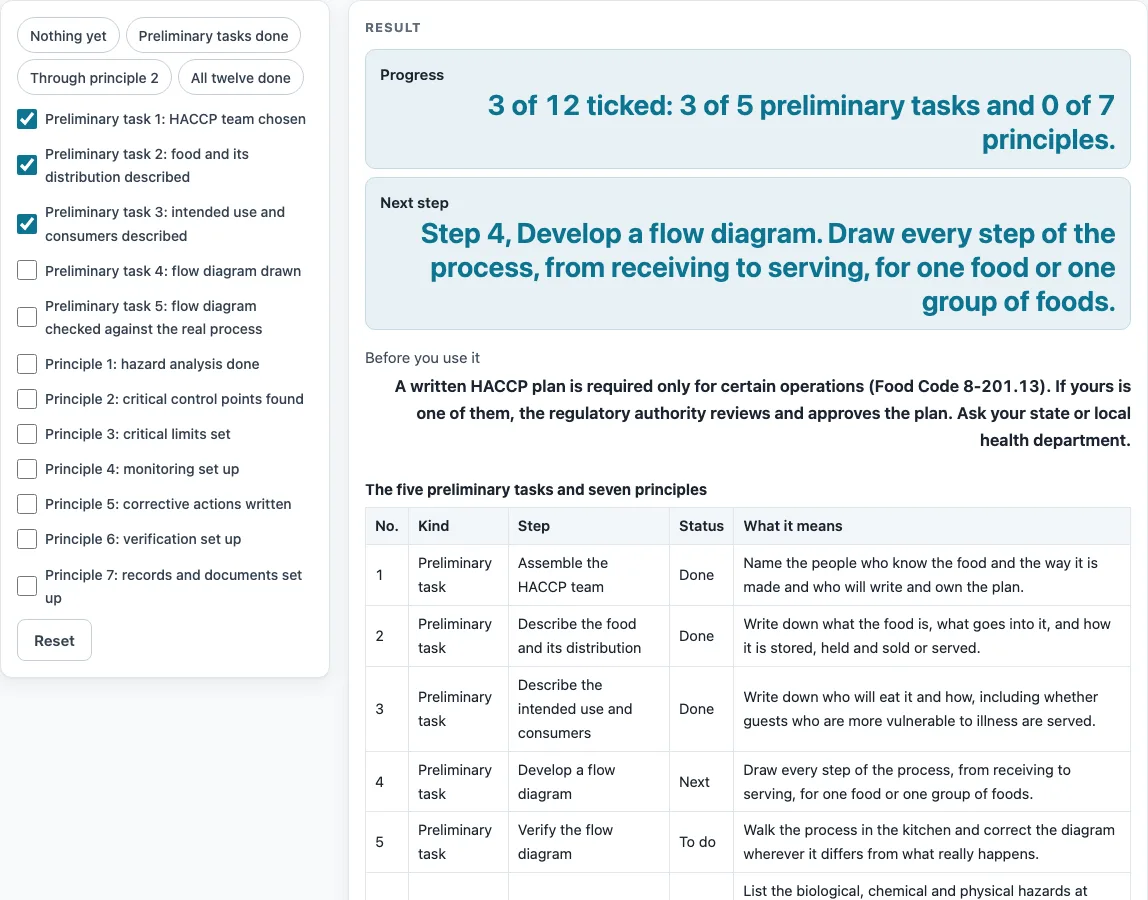
How to use the HACCP plan checklist
- Look at the twelve checkboxes. They appear in the order the guidelines present them: the five preliminary tasks first, then the seven principles.
- Notice the default state. The first three preliminary tasks are already ticked, so the output starts at 3 of 12 ticked.
- Read the output ’n of 12 ticked’. It also shows the split between tasks (of 5) and principles (of 7).
- Read the next unticked step. It names the next item in order and explains what that item means.
- Tick each item as you finish it. The table marks every item as Done, Next or To do.
- If a warning appears, go back. It appears when a later item is ticked while an earlier one is not.
- Choose a preset if you want a starting point: “nothing yet”, “preliminary tasks done”, “through principle 2” or “all twelve done”.
- When all twelve are ticked, the next-step text tells you to write the plan down and, if a regulator requires it, submit it for approval before starting the activity (Food Code 8-201.13).
Nothing is stored or uploaded. The state lives in the page address only, so the address is the only record of your ticks. Copy or bookmark it if you want to come back to the same progress, and use the table at the bottom for the plain definitions of a HACCP plan, a critical control point and a critical limit.
What is a HACCP plan?
A HACCP plan is the written document, based on the seven principles, that sets out the procedures to follow to control the food safety hazards in a specific food activity. It is built in two parts: five preliminary tasks, then seven principles.
What are the haccp principles?
The seven haccp principles are: conduct a hazard analysis; determine the critical control points; establish critical limits; establish monitoring procedures; establish corrective actions; establish verification procedures; and establish record-keeping and documentation. Their descriptions follow Food Code Annex 4 and the NACMCF text. Hazard analysis has two stages: identification first, then evaluation.
What are the haccp plan steps?
The haccp plan steps begin with the five preliminary tasks: assemble the HACCP team; describe the food and its distribution; describe the intended use and consumers; develop a flow diagram; and verify the flow diagram. The guidelines present the tasks first and the seven principles after them, so the checklist keeps that order.
What is the first step in developing a haccp plan?
The first step is to assemble the HACCP team. The guidelines place it before the food description, the intended use and consumers, and the flow diagram, so it is item 1 on the checklist.
What is a critical control point?
A critical control point is a step where control can be applied and is essential to prevent or eliminate a food safety hazard, or reduce it to an acceptable level. A critical limit is a maximum or minimum value, such as a temperature or a time, that must be met at that point. The decision tree for finding critical control points is on Critical Control Points: CCP Decision Tree.
Does a HACCP plan apply to every food business?
Food Code Annex 4 says HACCP at the retail level is generally voluntary. Your local health department adopts its own edition of the Food Code and may be stricter, so check its requirements. The When Is a HACCP Plan Required? page covers when a plan is needed.
Sources (checked 15 October 2026): fda.gov · fda.gov · fda.gov · fda.gov
Worked examples
| Input | Result |
|---|---|
| 3 of 12 steps ticked | Step 4, Develop a flow diagram. Draw every step of the process, from receiving to serving, for one food or one group of foods. |
| 0 of 12 steps ticked | Step 1, Assemble the HACCP team. Name the people who know the food and the way it is made and who will write and own the plan. |
| 12 of 12 steps ticked | All twelve are ticked. Write the plan down; if a regulator requires it, submit it for approval before you start the activity (Food Code 8-201.13). |
| 6 of 12 steps ticked | Step 7, Determine the critical control points. Find the steps where control can be applied and is essential to prevent or eliminate a hazard, or reduce it to an acceptable level. Cooking, cooling, hot holding and cold holding are the common examples in Annex 4. |
Calculated by the tool above; open it with the same values to see each step.
Frequently asked questions
Is a HACCP plan required by law?
It depends on your location and activity. Annex 4 says retail HACCP is generally voluntary, but your local health department’s adopted code governs and may be stricter.
Why are there twelve items?
The checklist includes the five preliminary tasks and the seven principles of the NACMCF HACCP guidelines, listed in the order the guidelines present them.
What happens if I tick a later item first?
A warning appears. The guidelines present the items in order, so the tool flags a later item ticked while an earlier one is still unticked.
Does ticking all twelve items approve my plan?
No. The next-step text says to write the plan down and, if a regulator requires it, submit it for approval before starting the activity (Food Code 8-201.13).
Which Food Code edition applies to me?
FDA lists the 2026 Food Code as the most recent full edition, and the sections used here are identical in the 2022 edition. States adopt their own edition, so your local regulator’s adopted code governs.
Does this tool check whether my food is safe?
No. It only tracks which of the twelve items you have ticked. It does not assess your food, your equipment or your operation.
Is my checklist saved?
No. Nothing is stored or uploaded, and the state lives in the page address only.
Related tools
- HACCP Plans and Critical Control Points: use this to see every HACCP page on this site in one place.
- Critical Control Points: CCP Decision Tree: use this when you need to work out whether a step is a critical control point.
- HACCP Plan Example: use this to see how the items might look in a completed plan.
- HACCP Plan for a Restaurant: use this when your food activity is a restaurant.
- HACCP Plan Template: use this when you want a blank layout to fill in.
- When Is a HACCP Plan Required?: use this to check when a plan is needed for your activity.
- Food Temperatures, Holding and Cooling: use this for the temperature limits a plan sets at its control points.
- Kitchen Checklists and Logs: use this for the logs that serve as monitoring and verification records.