When Is a HACCP Plan Required?
Pick what you do or plan to do, such as vacuum packaging, smoking food or processing seafood. The page shows what the cited rule says, which regulator to ask and what the plan must contain.
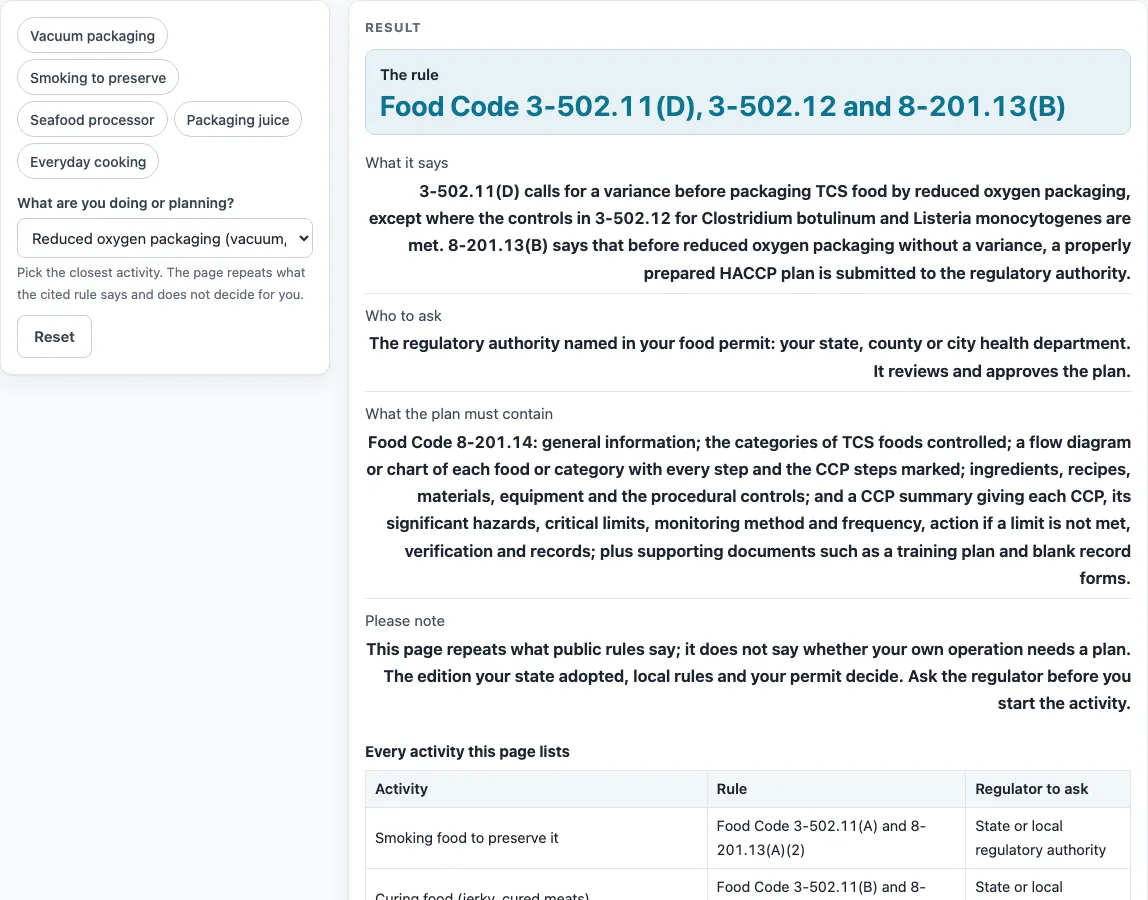
How to use the HACCP plan requirement lookup
- Under “What are you doing or planning?”, pick the activity that matches what you do, such as reduced oxygen packaging or seafood processing.
- Read the rule shown for that activity. It names the section, such as Food Code 3-502.11 or 21 CFR 123.6(b).
- Read what the rule says. This tells you when the rule requires a plan or a variance.
- Note the regulator to ask. For Food Code activities, that is the regulatory authority named in your food permit. For federal rules, it is the FDA or USDA FSIS. For a retail establishment, it is usually your state or local health department.
- Read the plan contents shown for that rule, so you know what the cited section says a plan must include.
- If a rule depends on a definition, such as the juice rules, read that definition and decide which case fits your operation. If you are unsure, ask the regulator.
- If your activity is not on the list, use the table of activities to compare, or ask your regulator directly.
The page also includes a table that lists every activity with its rule and the regulator to ask. Use it to compare several activities at once before you open the lookup for each one.
When is a HACCP plan required under the Food Code?
Under the FDA Food Code, section 8-201.13(A) requires a HACCP plan to be submitted to the regulatory authority for approval when law requires it, when a variance is needed under 3-401.11(D)(4), 3-502.11 or 4-204.110(B), or when the regulatory authority decides a method needs a variance. Section 8-201.13(B) also applies before reduced oxygen packaging is done without a variance.
Which activities need a variance?
Section 3-502.11 lists activities that need a variance. They include smoking as a means of preservation, curing, reduced oxygen packaging unless 3-502.12 is met, and sprouting seeds or beans. Juice packaged in a food establishment is treated under a HACCP plan to attain a 5-log reduction, or labeled as section 3-404.11 says. Ask the regulatory authority named in your food permit.
Does a restaurant always need a HACCP plan?
The tool does not say that any particular restaurant does not need one, and this guide does not say that either. For everyday cooking and holding, the Food Code lists do not name those activities. Annex 4 describes HACCP at retail as generally voluntary, but the law or the regulator may still require a plan.
What do the FDA and USDA rules say?
Under 21 CFR 123.6(b), a seafood processor needs a written HACCP plan whenever the hazard analysis finds hazards reasonably likely to occur. Section 123.3(k) says Part 123 does not apply to the operation of a retail establishment, so for retail, ask your state or local health department. Juice follows 21 CFR 120.8(a), which requires a written plan for each location and type of juice whenever hazards are reasonably likely. Section 120.3 defines a retail establishment as an operation that provides juice directly to consumers, so check which case applies to you. Under 9 CFR 417.2(b), every establishment under inspection has a written HACCP plan for each product. Section 303.1(d) says inspection requirements do not apply to operations traditionally conducted at retail stores and restaurants for normal retail quantities, with conditions. For the meat and poultry rule in 9 CFR 417, the regulator is USDA FSIS; for the seafood and juice rules in 21 CFR, it is the FDA.
What must a HACCP plan contain?
The required contents come from the cited rule. Use section 8-201.14 for Food Code activities, and 21 CFR 123.6(c), 120.8(b) and 9 CFR 417.2(c) for the federal rules.
Which code edition and local rules apply?
The FDA lists the 2026 Food Code as the most recent full edition, and the sections used on this page are identical in the 2022 edition. States adopt their own edition, and your local health department may be stricter. The adopted code, local rules and your permit decide what applies to your operation.
Sources (checked 15 October 2026): fda.gov · ecfr.gov · fda.gov · fda.gov · ecfr.gov · ecfr.gov · ecfr.gov
Worked examples
| Input | Result |
|---|---|
| Smoking food to preserve it | Food Code 3-502.11(A) and 8-201.13(A)(2) |
| Curing food (jerky, cured meats) | Food Code 3-502.11(B) and 8-201.13(A)(2) |
| Using vinegar or additives to preserve food or make it non-TCS | Food Code 3-502.11(C) and 8-201.13(A)(2) |
| Reduced oxygen packaging (vacuum, sous vide bags) | Food Code 3-502.11(D), 3-502.12 and 8-201.13(B) |
| Shellfish life-support display tank | Food Code 3-502.11(E), 4-204.110(B) and 8-201.13(A)(2) |
| Processing fish or fishery products (21 CFR 123) | 21 CFR 123.6(b), 123.3(k) |
| Everyday cooking, holding, cooling and reheating | Food Code 8-201.13, 3-502.11 and Annex 4 |
Calculated by the tool above; open it with the same values to see each step.
Frequently asked questions
Does this tool tell me my restaurant does not need a HACCP plan?
No. The tool never says that a particular restaurant does not need a plan. For everyday cooking and holding, the Food Code lists do not name those activities, but the law or the regulator may still require one, so confirm with your regulator.
Who do I ask about a HACCP plan requirement?
For Food Code activities, ask the regulatory authority named in your food permit. For seafood, ask the FDA, or your state or local health department if you are a retail establishment. For the USDA meat rules, ask USDA FSIS.
Does my local health department use the same code edition as the FDA?
Not necessarily. The FDA lists the 2026 Food Code as the most recent full edition, but states adopt their own editions. Your local health department’s adopted code governs, and it may be stricter.
What if the activity I do is not on the list?
The lookup throws an error for any activity that is not on its list, so it cannot show a rule for it. Use the table of activities to compare options, or ask your regulator directly.
Does the tool check whether my plan is good enough?
No. The tool shows the rule that applies and what the cited section says a plan must contain. It does not decide for your own operation or review a plan you have written.
Is a HACCP plan required for vacuum packaging or sous vide bags?
Reduced oxygen packaging falls under Food Code 3-502.11(D) and 3-502.12. Section 8-201.13(B) says that before reduced oxygen packaging without a variance, a HACCP plan is submitted to the regulatory authority. Your local health department adopts its own edition and may be stricter, so ask it first.
Related tools
- HACCP Plans and Critical Control Points: use it to see every HACCP page on this site in one place.
- Critical Control Points: CCP Decision Tree: use it to work through the decision questions for a hazard in your process.
- HACCP Plan Example: use it to see how a completed plan is laid out.
- HACCP Plan for a Restaurant: use it if you run a restaurant and want restaurant-specific context.
- HACCP Plan Template: use it when you are ready to start writing your own plan.
- What Is a HACCP Plan?: use it for a basic definition before you look up the rules.
- Food Temperatures, Holding and Cooling: use it for the Food Code temperature limits that apply to everyday cooking and holding.
- Kitchen Checklists and Logs: use it for the logs you keep whether or not a written plan is required.